A Benedictine Sacramental

The St. Benedict Medal

A centuries-old Catholic sacramental centered on the Cross of Christ, prayer, resistance to evil, and confidence in God.

Crux Sacra Sit Mihi Lux

May the Holy Cross be my light.

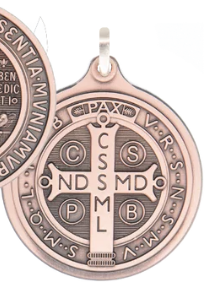
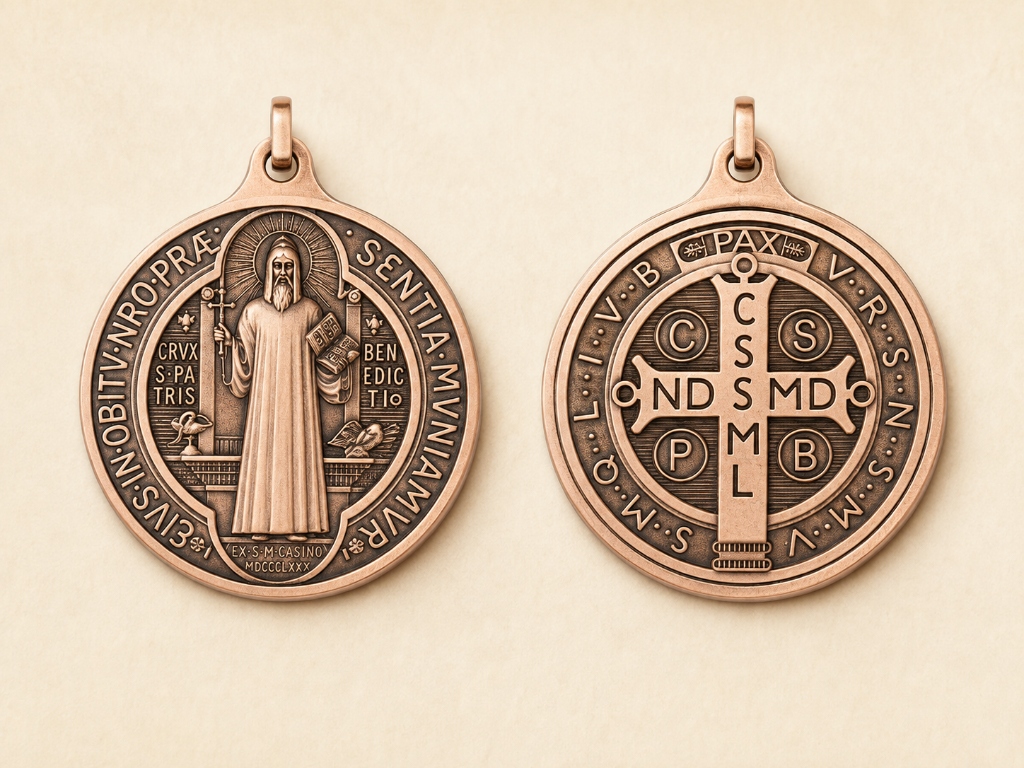
3/4 in. Copper St. Benedict Medal showing Front and Reverse sides

The Jubilee St. Benedict Medal · Front (Benedict) & Reverse (Cross of Peace)

From Nursia to Subiaco

Seeking God in Solitude & Discipline

Born around A.D. 480 in Nursia, Italy, St. Benedict grew up in a world marked by political collapse and moral disintegration. Disillusioned by the corruption and distractions of Rome, the young student withdrew into the wild hills of Subiaco to live as a hermit in a cave.

In that quiet solitude, Benedict sought one essential thing: to prefer nothing whatever to Christ. The Benedictine tradition is often summarized by the later expression Ora et Labora — prayer and work — pillars that transformed Western civilization:

Seeking God

Quaerere Deum

Silence & Prayer

Silentium et Oratio

Sacred Work

Labora et Devotio

Humility & Stability

Humilitas et Stabilitas
Traditional Accounts

Fidelity Under Trial: Accounts from St. Gregory the Great

Recorded in Book II of St. Gregory the Great's Dialogues, these traditional narratives illustrate Benedict’s reliance on the Cross of Christ during moments of spiritual and physical threat.

The Solitary Temptation

During his years at Subiaco, Benedict faced intense spiritual temptations. Rather than yielding or negotiating with sin, he responded with radical self-denial, making the Sign of the Cross and offering himself entirely to Christ.

Lesson: Spiritual fatherhood is born not by avoiding temptation, but by turning repeatedly to the Cross.

🍷

The Poisoned Cup

When lax monks resisted Benedict’s discipline and offered him a cup of poisoned wine, Benedict made the Sign of the Cross over the vessel. According to tradition, the glass instantly shattered as if struck by a stone.

Lesson: The Cross—not human power—shatters the hidden snares of evil.

🐦

The Poisoned Bread & Raven

When a jealous priest sent Benedict a poisoned loaf of bread, a raven that Benedict fed daily approached. Benedict commanded the bird to carry the loaf to a solitary place where it could harm no one, demonstrating divine providence.

Lesson: God protects His faithful servants and preserves the peaceful order of the Church.

The True Weapons

A Saint Formed in Spiritual Battle

“The Christian does not defeat evil by fascination with evil, but by belonging more completely to Christ.”

Benedictine spirituality does not obsess over demonology or sensational claims. Instead, it orders human life so thoroughly toward God that sin, vanity, and disorder lose their attraction. St. Benedict’s spiritual armor consists of everyday Catholic fidelity:

The Cross of Christ

Our ultimate light and refuge in temptation.

Daily Prayer & Scripture

Constant communion with the living God.

Sacramental Confession

Frequent restoration of sanctifying grace.

Fasting & Self-Discipline

Subduing disordered desires of the flesh.

Humility & Obedience

Rooting out spiritual pride and self-will.

Work Offered to God

Transforming daily labor into prayer.

Devotional History

How the Medal Developed Over Centuries

The St. Benedict Medal was not personally designed by St. Benedict himself, but developed over centuries as a cherished sign of Benedictine devotion.

1415

Discovery at Metten Abbey

A manuscript preserved at Metten Abbey in Bavaria depicted St. Benedict holding a cross along with mysterious initials corresponding to the Latin prayers against evil.

1647

Rediscovery & Deciphering

The Metten manuscript was rediscovered, allowing scholars to decipher the initials (C S P B, C S S M L, N D S M D, V R S N S M V, S M Q L I V B) as traditional Benedictine invocations.

1741–1742

Papal Approval by Benedict XIV

Pope Benedict XIV formally approved the medal devotion for the universal Church, granting indulgences for its prayerful use.

1880

The Jubilee Medal of Monte Cassino

To mark the 1,400th anniversary of St. Benedict's birth, the famous Jubilee Medal was struck under the supervision of the monks of Monte Cassino, becoming the canonical design used today.

Anatomy of the Medal

Understanding Every Symbol & Inscription

Every detail of the St. Benedict Medal carries profound spiritual meaning. Here is the full breakdown of both the Front and Reverse sides.

Front Side

The Holy Father Benedict

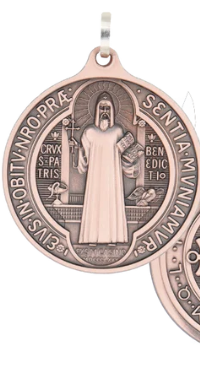
The front depicts St. Benedict holding the Cross in his right hand—his life's constant light—and his Holy Rule in his left hand.

Front of the St. Benedict Medal showing St. Benedict with Cross and Rule
1

The Cross in Hand

Represents Benedict’s devotion to the Cross of Christ and the power of the Sign of the Cross over evil.

2

The Holy Rule

Represents the monastic Rule of St. Benedict, calling all faithful to obedience, prayer, and work.

3

The Poisoned Cup & Raven

Flanking Benedict are the cup shattering at the Sign of the Cross and the raven carrying away the poisoned bread.

4

Surrounding Inscription

Crux Sancti Patris Benedicti (The Cross of Holy Father Benedict) and Eius in obitu nostro praesentia muniamur (May we be defended by his presence in the hour of our death).

Reverse Side

The Cross & Prayers of Spiritual Resistance

The reverse side features the central Cross surrounded by acronyms representing ancient Latin prayers rejecting Satan and affirming Christ.

Reverse of the St. Benedict Medal featuring the Cross and Inscriptions

PAX

Peace

The traditional Benedictine motto placed at the top of the Cross.

C S P B

Crux Sancti Patris Benedicti

The Cross of the Holy Father Benedict (located in the 4 arms of the Cross).

C S S M L

Crux Sacra Sit Mihi Lux

May the Holy Cross be my light (vertical bar of the Cross).

N D S M D

Non Draco Sit Mihi Dux

Let not the dragon be my guide (horizontal bar of the Cross).

V R S N S M V

Vade Retro Satana! Nunquam Suade Mihi Vana!

Begone, Satan! Never tempt me with vanities! (Outer margin, right side).

S M Q L I V B

Sunt Mala Quae Libas. Ipse Venena Bibas!

What you offer is evil. Drink the poison yourself! (Outer margin, left side).

Catholic Teaching

The Medal Is Not Magic

The St. Benedict Medal is a sacramental of the Church. Its power does not come from metal, symbols, or superstition. It directs the faithful toward Christ, the Holy Cross, prayer, repentance, and trust in God.

❌ What a Sacramental Is NOT

  • Not a magic charm, amulet, or talisman.
  • Does not possess inherent automatic supernatural power.
  • Does not replace personal prayer, repentance, or the sacraments.
  • Cannot be bought or sold for spiritual efficacy.

✓ What a Sacramental IS

  • A sacred sign turning the mind toward Christ.
  • Invokes the Church's official blessing and prayer.
  • Helps dispose the heart to receive God's grace.
  • Reminds the user to live a holy, prayerful life.

Having the medal blessed by a priest sets it apart for sacred use and joins it to the intercessory prayer of the entire Church.

Practical Devotion

Bringing the Medal Into Your Daily Catholic Life

Here are traditional ways Catholics reverently incorporate the St. Benedict Medal into their personal prayer and household life.

📿

Wear It

Wear on a neck chain as a constant reminder to belong to Christ and reject sin.

👛

Carry It

Keep in a pocket, wallet, or prayer kit for moments of silent aspiration.

🏡

Place in the Home

Reverently display near a crucifix, home altar, or doorway to bless your household.

Attach to a Rosary

Fix to your daily Rosary to join Benedictine prayer with the Marian mysteries.

🚗

Keep in the Car

Place in your vehicle as an encouragement to entrust travel to God's protection.

🎁

Give to a Loved One

Give to family or godchildren alongside an explanation of its sacred meaning.

A Simple Household Devotional Rhythm

  1. 1. Obtain a medal: Have your medal blessed by a Catholic priest.
  2. 2. Focus on Christ: Place yourself consciously in the presence of the Lord.
  3. 3. Learn the Latin inscriptions: Understand the prayer of the Cross.
  4. 4. Make the Sign of the Cross: Begin every prayer session with reverent faith.
  5. 5. Pray the Benedict Prayer: Crux Sacra Sit Mihi Lux.
  6. 6. Ask for Spiritual Protection: Pray for grace against temptation.
  7. 7. Display Reverently: Keep where it reminds you to pray daily.
  8. 8. Live the Sacraments: Combine devotions with Holy Mass & Confession.
A Daily St. Benedict Prayer Moment

Crux Sacra Sit Mihi Lux!

Non Draco Sit Mihi Dux!

Vade Retro Satana! Nunquam Suade Mihi Vana!
Sunt Mala Quae Libas. Ipse Venena Bibas!

Benedictine Family Life

Let Peace Begin in the Home

St. Benedict’s Rule offers timeless principles for domestic churches—helping families create homes anchored in order, peace, and hospitality.

What to Do During Temptation

  • Make the Sign of the Cross immediately over your heart.
  • Turn your attention directly to Christ rather than arguing with the temptation.
  • Pray the short aspiration: Crux Sacra Sit Mihi Lux.
  • Physically remove yourself from the occasion of sin.
  • Seek Sacramental Confession promptly if you fall.

Benedictine Rhythms for Families

  • Establish fixed morning and evening family prayer times.
  • Bless meals and welcome guests as if welcoming Christ Himself.
  • Guard what media and influences enter the home.
  • Balance work, study, rest, and prayer in daily routines.
  • Keep a blessed medal near your home doorway or family crucifix.
✦ Sanctus Coffee Welcome Gift ✦

Receive a Blessed St. Benedict Medal

For a limited time, new Sanctus Coffee customers may receive a blessed 3/4 in. copper St. Benedict Medal with their first qualifying order of $39+ or first coffee subscription shipment — while supplies last.

Blessed 3/4 in. Copper St. Benedict Medal

3/4 in. · Copper · Made in the USA · Blessed Gift

First qualifying purchase ($39+ or subscription) only. One per customer. While supplies last.