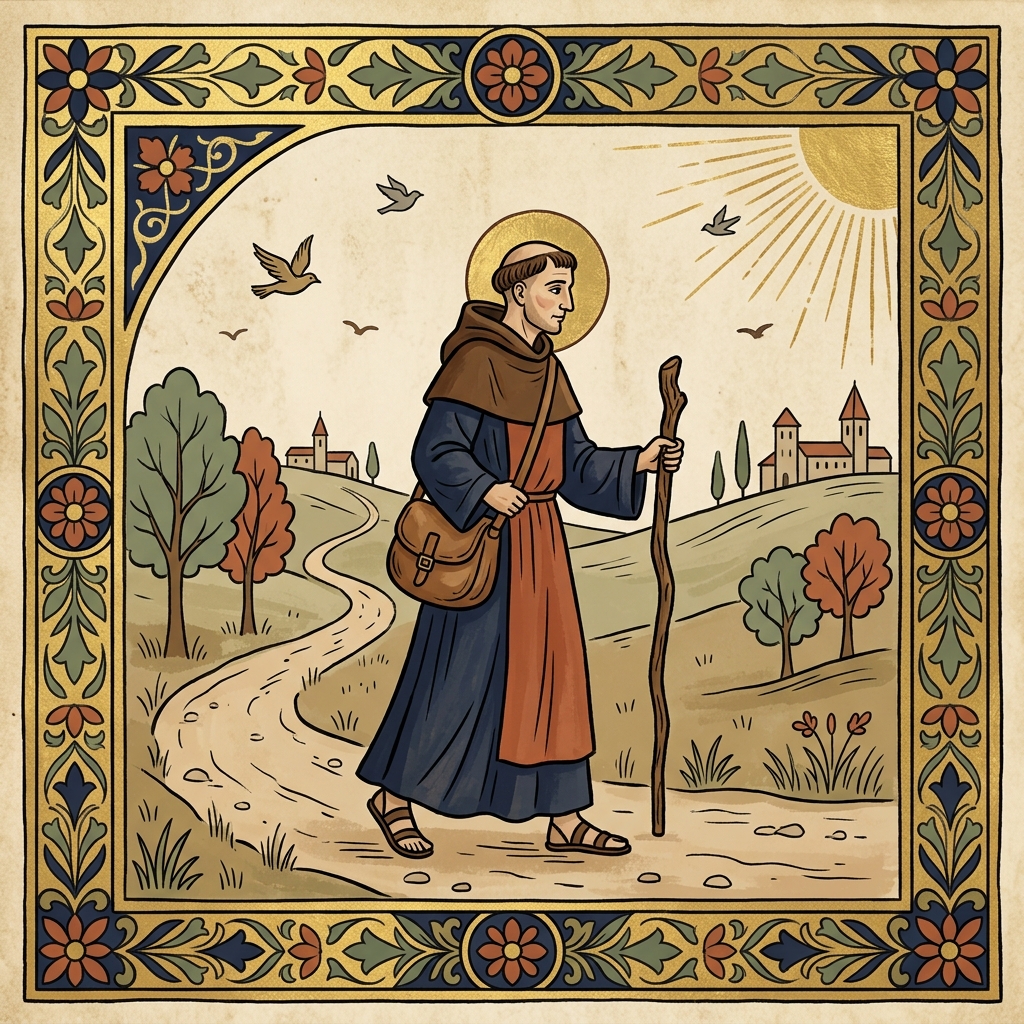
In the third century, amidst the cold, forested glades of Roman Gaul, a shepherd walked into the shadows of pagan darkness carrying nothing save the crozier of Christ and the unquenchable flame of the Gospel. His name was Denis—known to us today as Saint Denis of Paris—sent from Rome alongside his faithful companions, Rusticus and Eleutherius, to bring the warmth of divine grace to the ancient settlement of Lutetia.
Where idols of stone demanded blood and fear, Saint Denis preached the God of tender mercy, crucified and risen. Through his noble preaching, hearts were ignited, altars to false deities fell into ruin, and the first cathedral of Paris began to take root in the souls of men. Yet, as the kingdom of Christ expanded, the rulers of the age grew cold with fury. Denis and his brethren were seized, subjected to severe torments, and ultimately led up the highest hill outside the city—a place that would forever after be remembered as Montmartre, the Mountain of the Martyrs.
The Witness That Outlives the Sword
Tradition records that upon that hill, Saint Denis and his companions were beheaded for their refusal to burn incense to the emperor. Medieval legend recounts a wondrous sign: after the executioner’s axe fell, Denis stood, raised his severed head, and carried it two miles northward, surrounded by angels singing praises to the Almighty, until he reached the spot where his famous abbey would later stand. While modern eyes may view this miraculous account through the lens of pious medieval imagery, its spiritual meaning remains razor-sharp and unchanged throughout the centuries.
The decapitation of Saint Denis was intended by the Roman governor to be a total victory over the Church—a dramatic, violent severing of the shepherd from his flock to render the faithful leaderless and mute. Yet, the miracle of Montmartre declares that the witness of a martyr cannot be silenced by human violence. The head, though separated from the earthly body, continued to proclaim the glory of God. As the Psalmist declares, "The right hand of the Lord has done valiantly; I shall not die, but live, and declare the works of the Lord" (Psalm 118:15-17).
Saint Denis taught the early Church that the Gospel is not an earthly philosophy dependent on worldly power, safety, or political favor. It is a divine torrent that flows straight from the Heart of God, unstoppable even when the instruments of death are raised against it.
Sanctity in Times of Persecution and Confusion
For the Catholic pilgrim walking through the modern wilderness, the example of Saint Denis offers a profound remedy for the anxieties of our age. We live in a world that often seeks to decapitate the Truth—to separate the intellect from divine revelation, to sever society from its spiritual Head, which is Christ the King.
When Saint Denis entered Gaul, he did not wait for conditions to become favorable, nor did he alter the ancient faith to make it palatable to the pagan tribunals. He brought the unadulterated Truth in love, relying entirely upon the Holy Spirit to convert hearts. He understood that the bishop’s primary charge is not self-preservation, but the salvation of souls at any cost.
In the words of Saint John Chrysostom, "The road to heaven is narrow and steep, but it leads to the heavenly city. Let us not fear the combat, for the Crown is given to those who strive unto the end." Saint Denis wore that crown with a noble grace that commanded the reverence of all medieval Christendom, becoming one of the revered Fourteen Holy Helpers called upon in times of severe anguish and trial.
Practical Lessons for the Modern Pilgrim
How do we honor the memory of Saint Denis in our daily interior life? The noble witness of this third-century bishop provides us with three practical pathways for spiritual growth:
- Unshakable Loyalty to Truth: When pressed by worldly pressure to compromise your Catholic faith, stand firm. Saint Denis reminds us that earthly life is temporary, but fidelity to Christ endures unto eternity.
- Courageous Evangelization: Do not wait for a culture to be friendly toward Christ before sharing His light. Like Denis stepping into Roman Gaul, bring prayer, charity, and bold witness into the places where God seems most forgotten.
- Patience Under Trial: Saint Denis suffered cruel imprisonment before his execution, yet his peace remained anchored in the Eucharistic Heart of Jesus. Offer up your daily headaches, heavy burdens, and mental anxieties to Christ through Denis's heavenly intercession.
As the shadows lengthen across our own lands, let us pray for a restoration of the fearless spirit that animated the early martyrs. May we, like Saint Denis, walk through this earthly pilgrimage with our minds fixed firmly on Heaven, our lips ever ready to give glory to God, and our hearts burning with the holy fire of the Mission.
Reflection Question for Contemplation: In what area of your life is God calling you to stand courageously for the Truth, even when doing so requires suffering, misunderstanding, or the loss of worldly comfort?