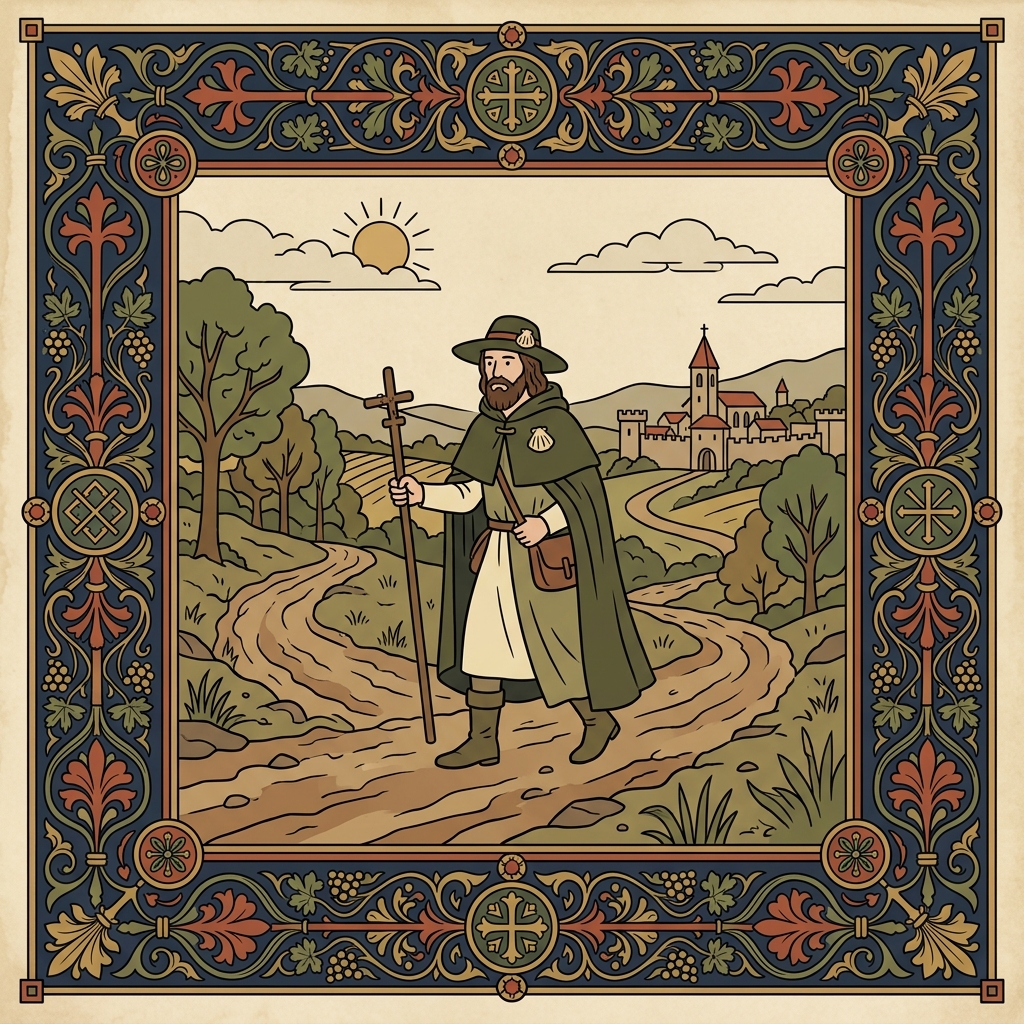
On this twelfth day of July, Holy Mother Church raises her eyes to a saint whose life was forged in the crucible of a most dramatic conversion. Before he was a holy abbot and the founder of the Vallumbrosan Order, Saint John Gualbert was a Florentine knight bound by the heavy, suffocating chains of a blood feud. In an age where honor was often measured by the edge of a sword, his story stands as a towering testament to the supremacy of divine mercy over human vengeance.
A Blood Feud in the Streets of Florence
Born into nobility in the early eleventh century, John Gualbert lived a life expected of his station—steeped in chivalric pride, martial prowess, and worldly ambition. When his beloved brother Hugo was murdered, the expectations of his family and his culture demanded one thing: blood. John took upon himself the solemn duty of the avenger, hunting the man who had struck down his kin.
The fateful encounter occurred on a narrow, winding road on Good Friday. Accompanied by his armed retainers, John cornered the murderer in a passage too tight for escape. Drawing his sword, the knight prepared to execute the justice of the world. But the murderer, defenseless and recognizing his imminent doom, fell to his knees. Crossing his arms over his chest to form the shape of a cross, he cried out: "For the sake of Him who died on the cross this day, I beg you, spare my life."
The Crucifix That Bowed
In that singular, breathless moment, grace pierced the iron defenses of John’s heart. The appeal to the Crucified King—the One who shed His own blood to ransom His enemies—halted the knight's hand. John dropped his blade, lifted his brother's murderer from the dirt, and embraced him, offering not only his life but his complete and absolute forgiveness.
Overwhelmed by the spiritual earthquake that had just shaken his soul, John immediately ascended the hill to the Benedictine monastery of San Miniato al Monte. Entering the church, he cast himself before a prominent wooden crucifix to pray and weep over his own sins. Tradition holds that as John prayed, the painted corpus of Christ miraculously bowed its head toward him—a visible, divine acknowledgment of his heroic act of mercy. He had spared a man for Christ's sake, and Christ, in turn, welcomed him into the sublime intimacy of His grace.
The Cloister of Vallombrosa
The world of knights, banners, and nobility no longer held any sway over John. The incident had burned away the dross of his worldly ambitions. He traded his finely wrought armor for the coarse habit of a monk. Seeking a more austere and solitary life than what he found at San Miniato, he eventually journeyed to the shaded, silent forests of Vallombrosa. There, he founded a new monastic community rooted in a strict interpretation of the Rule of Saint Benedict.
Saint John Gualbert became a relentless champion against the corruptions of his day, fiercely opposing simony and clerical abuses. The hands that once sought to shed blood in vengeance were now folded in unceasing prayer for the purification of the Church. As Saint Augustine wisely noted in his teachings, "Forgiveness is the restoration of freedom to oneself." John Gualbert found his ultimate freedom not in vindictive justice, but in the cloistered silence of surrender to the Almighty.
Laying Down Our Swords
We may not walk the cobblestone streets of medieval Florence, nor carry steel at our hips, but the human heart remains unchanged. We still harbor resentments, nurse our wounded pride, and seek the petty vengeance of the silent treatment, the biting remark, or the withheld apology. We strap on the heavy armor of grudges, believing it protects us, when in truth, it only weighs us down and suffocates the life of sanctifying grace within the citadel of the soul.
Saint John Gualbert challenges us to confront our own internal "blood feuds." When we are wronged, the world encourages us to demand our rights, our pound of flesh, our justified anger. Yet, the cross of Jesus Christ stands as a stark and absolute contradiction to the economy of the world. Mercy is not the softening of justice; it is a profound participation in the chivalry of Heaven. It requires far greater fortitude to lay down the sword of resentment than it does to strike a blow.
As we honor this noble saint today, let us look to the crucifix. Christ bows His head to those who show mercy, for in doing so, they become living icons of His own Sacred Heart. Let us not wait for a miraculous sign to forgive those who have trespassed against us. Let us simply look to the wood of the cross, and remember the ransom paid for our own souls.
Reflection Question: Who in your life are you currently withholding forgiveness from, and what "sword" is Christ asking you to lay down at the foot of His cross today?