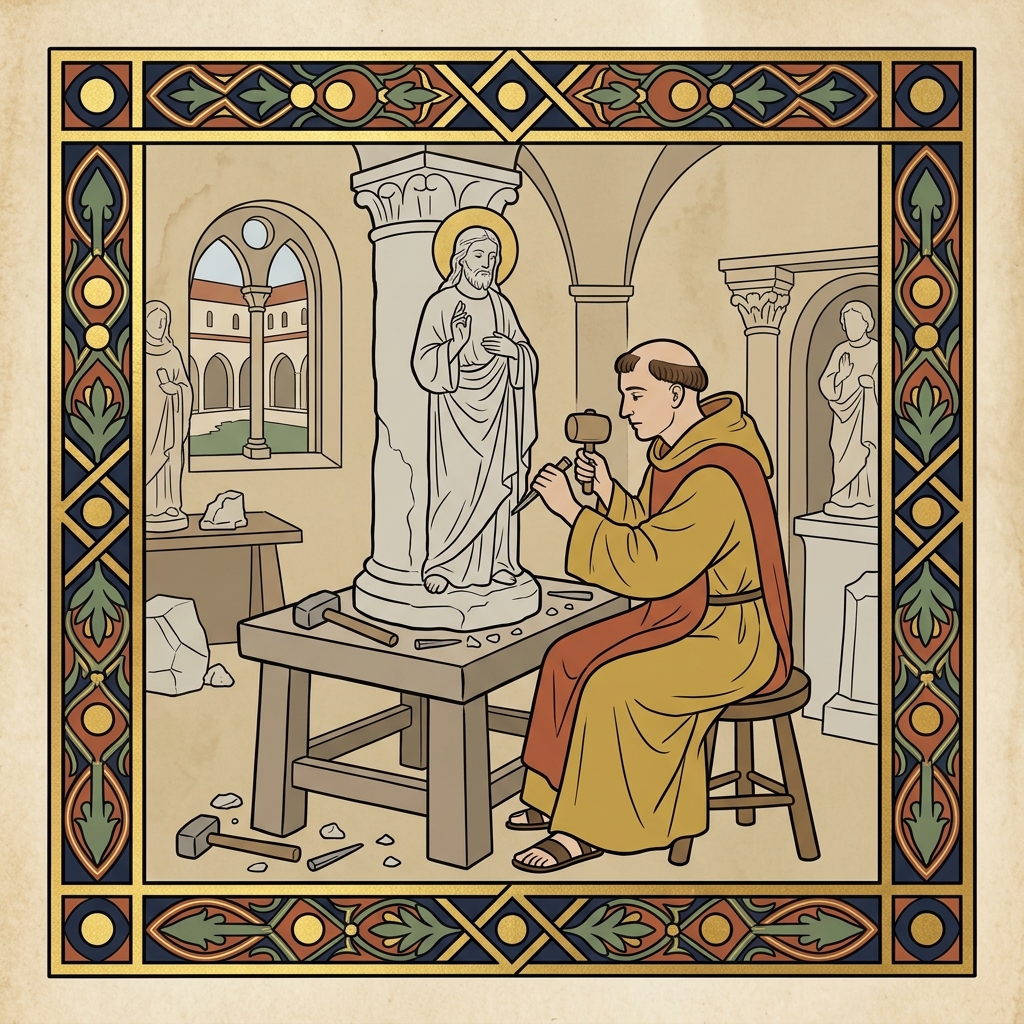
In a world increasingly dominated by mass production, fleeting trends, and disposable goods, there is a profound, quiet rebellion found in the intentional work of human hands. Catholic craftsmanship is more than simply making things; it is the physical manifestation of our faith, a tangible expression of beauty, truth, and goodness. Whether you are carving wood, roasting coffee beans, writing code, or tending to a home, the Catholic vision of work elevates the mundane to the sacred. By embracing this approach, we do not merely produce commodities; we participate in the creative act of God Himself, offering our daily labor as an act of profound worship.
\n\nThe call to holy work is not restricted to those who build grand cathedrals or paint majestic frescoes. It is a universal invitation. Every vocation requires a level of diligence, intention, and love that can transform the ordinary into the extraordinary. When we approach our daily tasks with the mindset of a true artisan, we begin to see that our desks, our kitchens, and our workshops are all altars where we can offer our efforts to the Lord.
\n\nThe Theological Foundation of Catholic Craftsmanship
\n\nTo understand the depth of Catholic craftsmanship, we must look back to the very beginning. In the Book of Genesis, God is revealed as the ultimate Creator, fashioning the universe with order, purpose, and breathtaking beauty. When He created humanity in His image and likeness, He endowed us with a spark of that creative genius. We are made to make.
\n\nHowever, the Catholic understanding of work is distinct from the secular view. The modern world often sees work merely as a necessary evil, a means to acquire wealth, or a ladder to achieve status. In contrast, the Church teaches that human labor is inherently dignified. Pope St. John Paul II, in his encyclical Laborem Exercens, beautifully articulated that through work, humanity not only transforms nature but also achieves fulfillment as human beings.
\n\nCatholic craftsmanship takes this dignity a step further. It insists that the way we work matters just as much as the outcome. A craftsman guided by faith seeks excellence not out of pride, but out of a desire to reflect the perfection of the Creator. The materials used are treated with respect, recognizing them as gifts from the earth. The time invested is seen as a sacrificial offering. In this light, a beautifully crafted table, a carefully prepared meal, or a well-roasted batch of coffee becomes a testament to the goodness of God's creation.
\n\nChrist the Carpenter: Our Ultimate Model for Catholic Craftsmanship
\n\nWe cannot discuss the dignity of labor without gazing upon the life of Jesus Christ. For the vast majority of His earthly life—often referred to as His \"hidden years\"—the Son of God was a tradesman. He worked with His hands in the humble shop of St. Joseph in Nazareth. He measured, He cut, He sanded, and He built.
\n\nThis reality is staggering. The Word through whom all things were made chose to spend decades shaping wood. In doing so, Christ sanctified human labor forever. He demonstrated that true Catholic craftsmanship requires patience, precision, and humility. Jesus did not rush His work; He did not cut corners to maximize profit. We can faithfully imagine that every yoke He carved and every table He leveled was made with perfect care, intended to serve His neighbors well and to give glory to His Father.
\n\nWhen we strive for excellence in our own work, we are imitating Christ the Carpenter. We are recognizing that the sweat of our brow and the fatigue of our muscles have redemptive value. By uniting our daily efforts with His, we allow His grace to flow through our hands and into the world.
\n\nThe Monastic Tradition: Ora et Labora
\n\nThroughout Church history, the integration of faith and work has been most vividly lived out in the monastic tradition. The Rule of St. Benedict introduced the guiding principle of Ora et Labora—Pray and Work. For the monks, there was no strict division between the time spent chanting the Psalms in the choir and the time spent brewing beer, copying manuscripts, or tending the fields.
\n\nIn the monastic mindset, the work itself becomes a form of prayer. A monk practicing Catholic craftsmanship in the scriptorium, carefully illuminating a Bible with gold leaf and vibrant pigments, knew that his painstaking effort was a direct act of adoration. Similarly, the brothers who labored in the fields understood that cultivating the earth was a way of participating in God's ongoing providence.
\n\nThis integrated approach is exactly what the modern soul desperately needs. We often compartmentalize our lives, separating our Sunday worship from our Monday workday. But the monastic tradition teaches us that when our labor is ordered toward God, it becomes sanctified. We can bring the quiet peace of the cloister into our modern workshops and offices by offering short prayers before beginning a task, by maintaining a spirit of inner silence, and by working with a pure intention to serve others.
\n\nReviving Catholic Craftsmanship in the Modern World
\n\nToday, there is a growing hunger for authenticity. People are increasingly disillusioned with cheap, mass-produced goods that lack soul and durability. This cultural shift presents a tremendous opportunity for a revival of Catholic craftsmanship. When artisans create products that are built to last, that prioritize beauty, and that respect the dignity of the materials, they offer a powerful counter-narrative to the culture of disposability.
\n\nBut how do we revive this spirit in a fast-paced, digital world? It begins with a shift in perspective.
\n\n- \n
- Embrace Slowness: True craftsmanship cannot be rushed. It requires the patience to learn a skill deeply and the discipline to execute it well. We must resist the urge for instant gratification and embrace the slow, steady process of creating something of lasting value. \n
- Prioritize Beauty: Beauty is not a luxury; it is a necessity for the human soul. A well-crafted object should not only be functional but also point the mind toward the transcendent. Whether it's the elegant curve of a wooden chair or the rich, complex flavor profile of an ethically sourced coffee, beauty elevates our daily experience. \n
- Value the Worker: Catholic social teaching demands that we respect the dignity of the worker. When we purchase goods, we should seek out artisans and companies that provide fair wages and foster a healthy working environment. Our consumption should align with our values. \n
Storytelling: The Artisan's Prayer
\n\nConsider the story of a humble woodworker named Thomas. For years, Thomas carved crucifixes in a small, dusty garage. He wasn't famous, and he didn't make a great deal of money. Yet, his work was profoundly sought after by the local parishes.
\n\nWhy? Because Thomas didn't just carve wood; he prayed it. Before selecting a piece of walnut or maple, he would trace the grain with his fingers, thanking God for the tree that had grown it. As he chiseled away the excess, shaping the corpus of Christ, he would meditate on the Passion. Every strike of the mallet was a rhythmic prayer: \"Lord Jesus Christ, have mercy on me.\"
\n\nThomas viewed his craft not as a job, but as a vocation. He understood that the crucifixes he made would hang in homes, bearing witness to family prayers, comforting the sick, and welcoming newborns. His Catholic craftsmanship was a silent, powerful ministry. He poured his faith into the wood, and in return, the wood became a vessel of grace for others. Thomas teaches us that the spiritual weight of our work is determined not by its scale, but by the love with which it is executed.
\n\nPractical Application: Bringing Craftsmanship to Your Vocation
\n\nYou do not need to be a professional woodworker, painter, or coffee roaster to practice Catholic craftsmanship. The principles of intentionality, excellence, and prayerful offering can be applied to every single vocation. Here is how you can practically bring this spirit into your daily life:
\n\n1. Offer Your Morning to God
\nBegin your day with a Morning Offering. Before you open your laptop, pick up a tool, or begin tending to your children, consciously give the day's labor to the Lord. A simple prayer—\"Lord, I offer You all my prayers, works, joys, and sufferings of this day\"—sets the spiritual trajectory for everything that follows.
\n\n2. Strive for Hidden Excellence
\nIn a culture that constantly demands attention and praise, strive to do good work even when no one is watching. Fix that hidden line of code, clean that unseen corner of the house, or double-check those financial numbers with the knowledge that God sees your effort. Excellence in the hidden things is the hallmark of true integrity.
\n\n3. Work with Gratitude
\nWhen frustration sets in—when the project fails, the deadline looms, or the exhaustion hits—pause and give thanks. Gratitude shifts our focus from our struggles to God's providence. Thank Him for the mind to solve problems, the hands to labor, and the opportunity to serve others through your work.
\n\n4. Sanctify Your Workspace
\nJust as a craftsman organizes his tools, organize your environment to remind you of your ultimate purpose. Keep a small crucifix on your desk, a holy card tucked in your planner, or a rosary in your pocket. These small visual cues can draw your mind back to prayer during busy moments.
\n\nSpiritual Reflection: The Sanctus Mission Connection
\n\nAt the heart of the Christian life is the desire to build the Kingdom of God. Every small act of Catholic craftsmanship is a brick in that eternal edifice. When we labor with love, we are helping to restore the beauty and order of a fallen world. We are participating in the redemption of all things.
\n\nThis is the driving force behind everything we do at Sanctus Mission. We believe that faith should not be confined to Sunday mornings. It should permeate our Monday mornings, our coffee breaks, our conversations, and our labor. By fostering a deep, abiding Catholic faith that touches every aspect of daily existence, we become more fervent disciples, ready to transform the world.
\n\nWhen you sit down with a cup of coffee to read, to pray, or to begin your workday, you are stepping into that monastic rhythm of Ora et Labora. That moment of quiet contemplation fuels the holy work you are called to do. It is a cycle of grace: we pray to work well, and we work well to glorify God.
\n\nConclusion
\n\nThe world is desperate for the witness of faithful Catholics who do their jobs with joy, integrity, and exceptional skill. By embracing the sacred art of Catholic craftsmanship, we reject the mediocrity of the modern age and answer the high calling of our Creator. We transform our daily grind into a liturgy of labor.
\n\nLet us remember Christ the Carpenter, who dignified the work of human hands. Let us look to the monks who wove prayer into every task. And let us step into our own workshops, offices, and homes with a renewed sense of purpose. For when work is done with a pure heart and offered to God, there is nothing ordinary about it. It becomes a masterpiece of grace.
\n\nSupport Catholic Craftsmanship Through Sanctus Mission
\n\nIf this vision of intentional, faith-filled living resonates with you, we invite you to make it a part of your daily routine. Every cup of Sanctus Coffee is roasted with this same spirit of dedication and excellence, designed to be the perfect companion for your morning prayer and contemplation.
\n\nFurthermore, every purchase you make directly supports real Catholic missions, spreading the Gospel and aiding those in need around the world. Visit our store to explore our artisan roasts, and join us in our mission to build up the Kingdom of God, one cup, and one holy task, at a time.