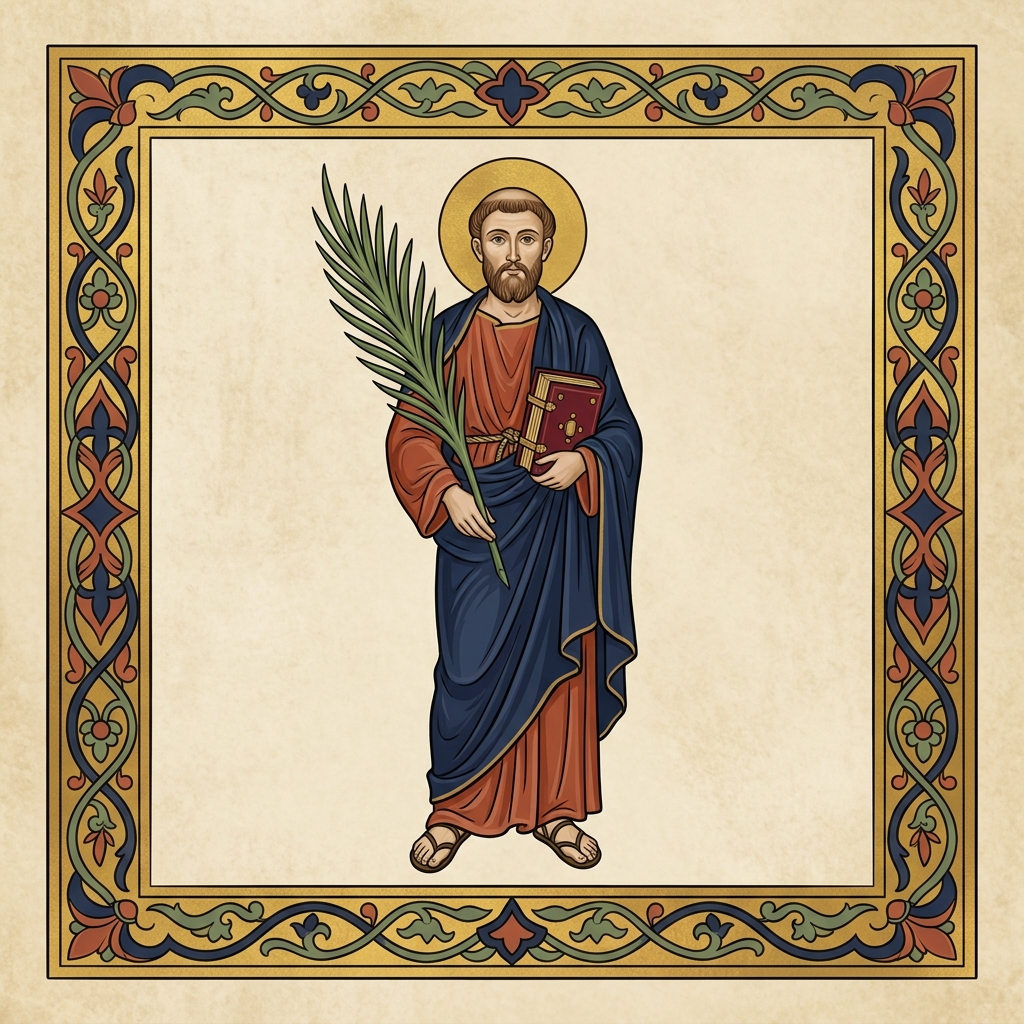
In an age where a myriad of fleeting voices clamor for the allegiance of the soul, the ancient pursuit of Truth remains the most noble of human endeavors. As the Church turns her liturgical gaze toward the first day of June, we encounter a titan of the early Christian era, a man who traversed the vast landscapes of human wisdom only to kneel before the crib and the cross. We speak, of course, of St. Justin Martyr.
Born in the ancient region of Samaria at the dawn of the second century, Justin’s life is a testament to the restless heart spoken of by St. Augustine. He is a shining patron for all those who seek the True, the Good, and the Beautiful in a world obscured by shadows. His feast day invites us to don the spiritual cloak of the philosopher, seeking not the fleeting approval of the world, but the eternal gaze of the Divine Logos.
The Philosopher's Quest
To understand the magnitude of St. Justin’s conversion, one must first understand the depth of his hunger. In the ancient world, philosophy was not merely an academic discipline confined to the walls of a university; it was a total way of life. Young Justin sought out the greatest intellectual masters of his day. He apprenticed himself to the Stoics, but found them lacking in the knowledge of God. He turned to the Aristotelians, the Pythagoreans, and finally the Platonists, whose contemplation of immaterial things gave his mind wings.
Yet, even at the heights of human reasoning, Justin found a lingering emptiness. Platonic philosophy could point to the existence of a higher reality, but it could not bridge the chasm between the Creator and the creature. It offered an abstract ideal, not a God who loved, wept, and bled for His creation. The human intellect, noble as it is, can only reach so far before it requires the ladder of Divine Revelation.
The Encounter by the Sea
The turning point of Justin’s life reads like a scene drawn from a sacred romance. Walking in solitary contemplation along the shores of the sea, he encountered an enigmatic old man. This venerable elder engaged the young philosopher in a profound dialogue. With gentle precision, the old man exposed the limitations of human philosophy and directed Justin's eyes away from the Greek masters and toward the Hebrew prophets.
The elder spoke of men who were older than the philosophers, men who were righteous and beloved by God, who spoke by the Divine Spirit and foretold events that had come to pass. They had prophesied the coming of the Christ. In his renowned Dialogue with Trypho, Justin recounts the transformative grace of this moment:
"A fire was suddenly kindled in my soul. I fell in love with the prophets and these men who had loved Christ; I reflected on all their words and found that this philosophy alone was true and profitable. And thus, and for this reason, I am a philosopher."
The sea, ever a symbol of chaos and the unknown, became for Justin the very threshold of grace. He had encountered the Living God, not as a distant prime mover, but as Jesus Christ, the Incarnate Word.
The Apologist's Fiat
Conversion for Justin did not mean the abandonment of his intellect. Unlike some who viewed worldly wisdom with utter disdain, Justin believed that wherever truth is found, it belongs to Christ. He boldly continued to wear the pallium, the distinctive cloak of a philosopher, signaling to the pagan world that Christianity was not a rustic superstition, but the highest and truest philosophy.
He traveled to Rome and founded a school, dedicating his life to the defense—the apologia—of the Catholic Faith. His surviving writings, particularly his First and Second Apologies addressed to the Roman Emperor, remain foundational treasures of Sacred Tradition. Within these ancient texts, we find some of the earliest descriptions of the Holy Mass, a beautiful confirmation that the Eucharist we receive today is the very same Sacrifice offered by the early Church.
St. Justin defended the innocence of Christians against vile pagan rumors, employing unyielding logic and profound charity. But earthly emperors rarely reward heavenly wisdom. Around the year 165 AD, under the reign of Marcus Aurelius—a philosopher-emperor who tragically could not recognize the True Philosopher standing before him—Justin and six companions were arrested, scourged, and beheaded for refusing to sacrifice to false idols. He purchased the ultimate wisdom with the currency of his own blood.
Lessons for the Modern Pilgrim
How, then, does a modern Catholic emulate this second-century giant? We find ourselves traversing a cultural landscape that is, in many ways, reverting to the paganism of Justin's era. We are surrounded by modern Stoics and materialists, by those seeking truth in the labyrinth of the self rather than in the revelation of the Savior.
St. Justin teaches us to recognize the "seeds of the Word" (Logos spermatikos) scattered throughout our culture. Wherever there is a genuine pursuit of goodness or a hunger for justice, there is fertile ground for the Gospel. We are called to meet the modern world not with bitter condemnation, but with the radiant, confident truth of the Incarnation. We are called to study our Faith deeply, to understand its mysteries, and to articulate them with a charity that disarms the skeptic and invites the seeker.
Like Justin, we must be willing to stake our very lives upon the Truth we have found in the Eucharist. We must wear the cloak of our baptismal calling with noble defiance against a world that demands our conformity.
Reflection Question: In your daily encounters with a culture that has forgotten God, where is the Lord asking you to bravely don the philosopher’s cloak and speak the truth of Christ with both reason and unyielding charity?