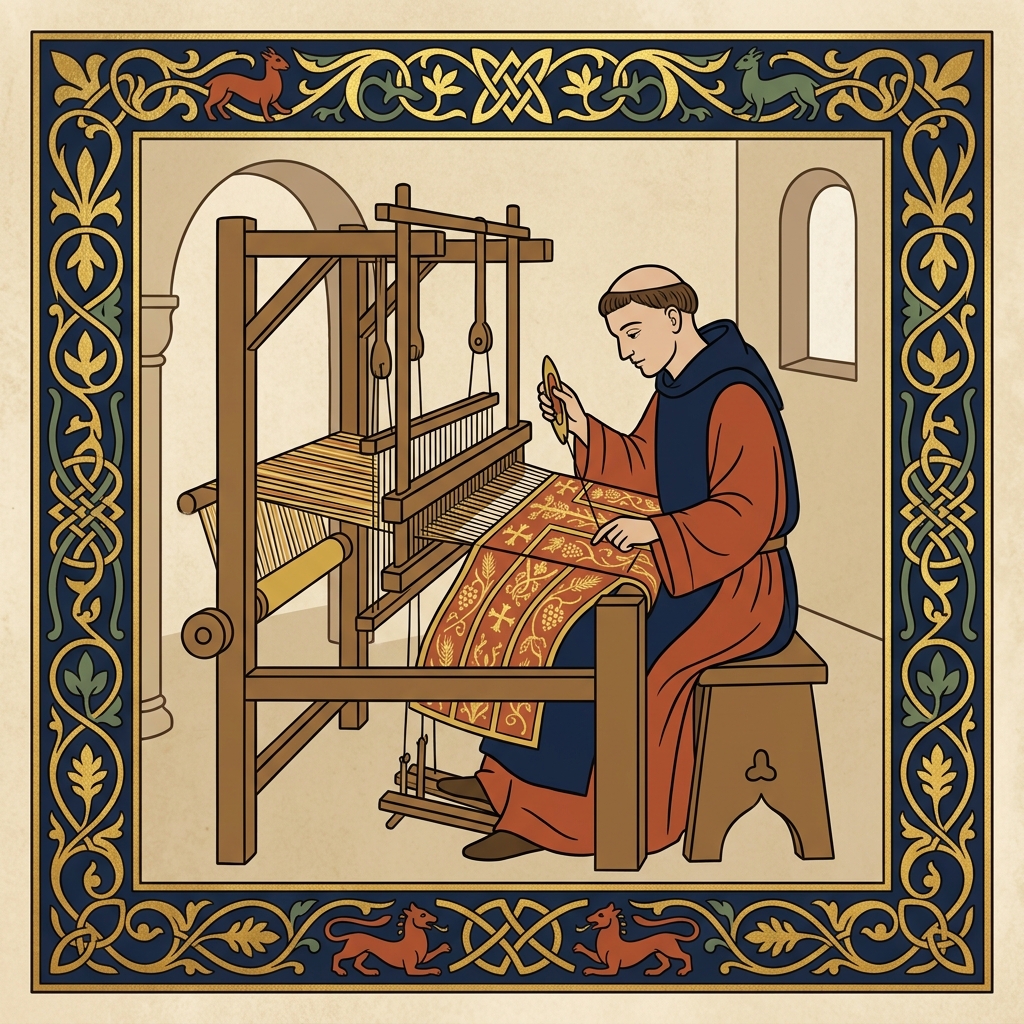
In a sunlit workshop tucked within the shadow of a quiet monastery in the rolling hills of the Hudson Valley, the air smells of aged calfskin, boiled linseed oil, and pulverized oak galls. Here, Master Bookbinder Gabriel Vance works in solemn stillness, his weathered hands smoothing a sheet of twenty-three-karat gold leaf over the crimson edge of a hand-sewn Altar Missal.
In an age dominated by glowing pixels and disposable paperbacks, Gabriel’s craft belongs to a different order of reality. He is a sacred artisan—a man who spends hundreds of hours constructing a single volume meant to rest upon the holy altar of God.
The Weight of the Written Word
“When you bind a liturgical book,” Gabriel explains, setting down his camel-hair brush with practiced grace, “you are not merely packaging text. You are creating a tabernacle for the Holy Word. The priest who lifts this Missal during the Holy Sacrifice of the Mass ought to feel, through its weight and texture, the solemnity of what he holds.”
On this twentieth day of August, the Church celebrates the feast of Saint Bernard of Clairvaux, the great Cistercian Doctor of the Church whose love for the divine Word burned like a furnace. Saint Bernard once wrote, “The Word of God is the food of the soul, its strength, and its light.” For Gabriel, that theological truth demands a corresponding physical reverence. If the Word is divine food, the vessel that carries it into the sanctuary must be crafted with sacrifice, precision, and beauty.
Needle, Cord, and Pure Gold
The process of creating a sacred volume in the traditional medieval manner is painstaking. It begins with fine cotton rag paper or parchment, folded into signatures. Gabriel hand-sews these sections around heavy linen cords using unbleached flax thread—a technique virtually unchanged since the twelfth century. This creates an indestructible structure capable of enduring centuries of liturgical use.
Next comes the edge-gilding. Gabriel applies a mixture of bole—a soft red clay—and glair made from beaten egg whites to the polished paper edges. He then gently lays paper-thin leaves of genuine gold across the surface before burnishing them with a smooth agate stone until they shine like polished armor.
“The gold on the page edges is not mere ornamentation,” Gabriel notes, tracing the brilliant golden border of the book. “Historically, gilding protected the pages from dust, light, and humidity. Spiritually, it reminds us that the words contained within are incorruptible and heavenly.”
Craft as a Form of Contemplation
To watch Gabriel work is to observe a form of monastic labor. Every tool in his workshop—the brass hand-stamps, the heavy iron standing press, the bone folders carved from oxen horn—has been passed down or restored with care. There are no power tools here; the rhythm is set by the breathing of the artisan and the steady ticking of a wall clock.
In a world characterized by swiftness and planned obsolescence, sacred bookbinding insists upon permanence. It stands as a silent protest against a throwaway culture. When Gabriel blind-tools an image of the Sacred Heart or the Chi-Rho into rich vegetable-tanned leather, he knows he will likely never see the day the cover wears out.
“An artisan must conquer his ego,” he reflects. “My name will not appear on the title page. Centuries from now, when priests still turn these pages during the Canon of the Mass, no one will remember who bound it. They will only see the glory of God rendered in leather and gold. That is enough.”
As Saint Paul wrote to the Colossians: “Whatever you do, work heartily, as for the Lord and not for men.” In the hands of a master artisan, every stitch of thread and brush of gold leaf becomes an unceasing prayer of praise.
Reflective Question for the Soul: In your own daily work, how might you cultivate a spirit of craftsmanship and reverence that offers your very best to God, regardless of who sees it?