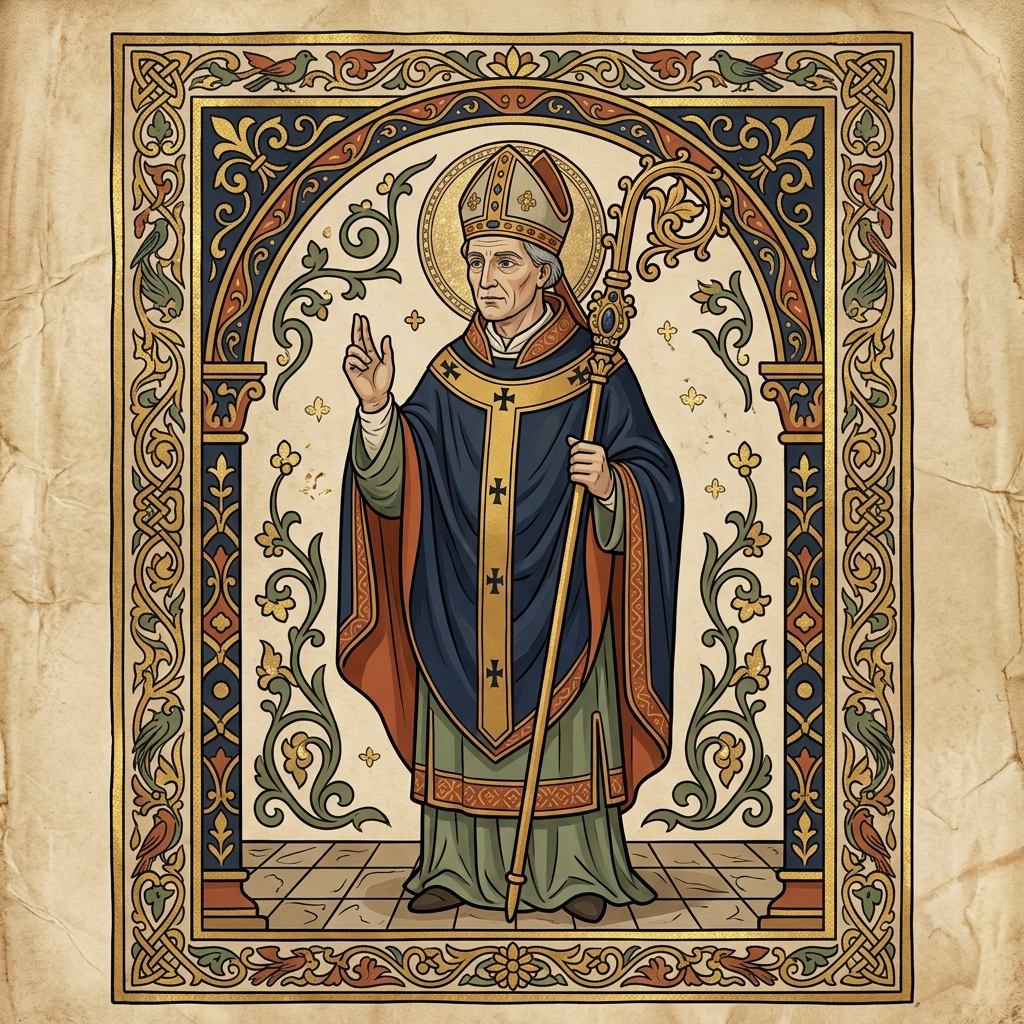
In the golden twilight of late September, the Holy Mother Church turns her reverent gaze toward one of her most radiant sons: Saint Vincent de Paul. Known throughout the ages as the Apostle of Charity, this noble priest lived not in the quiet solitude of a monastic enclosure, but amidst the raw, aching wounds of seventeenth-century France. Yet, despite the chaotic squalor that surrounded his daily labors, his soul remained an unshakeable sanctuary, anchored firmly in the Sacred Heart of Jesus Christ.
From Captivity to Divine Calling
Born to humble peasants in Gascony in 1581, Vincent’s early ambitions were far from grand sanctity. Like many young men of his era, he initially pursued the priesthood as a means to secure a comfortable life and a respectable benefice. However, Divine Providence frequently uses our human frailties as the forge for royal virtue. Through a harrowing series of trials—including his sudden abduction by Barbary pirates and two arduous years spent in captivity in Tunis—Vincent’s heart was systematically stripped of worldly ambition.
Upon his miraculous escape and return to European shores, he emerged fundamentally transformed. He no longer saw the priesthood as a path to personal security, but as a total immolation of self for the salvation of souls. He came to recognize that the true measure of a Christian vocation lies not in high standing, but in absolute surrender to the Divine Sovereign. As Saint Vincent would later write with characteristic zeal, "I must love God, but let it be with the strength of my arms and the sweat of my brow."
Seeing Christ in the Afflicted
Saint Vincent did not merely distribute material alms; he recovered a profound theological truth that sits at the very core of Catholic tradition: the poor are not burdens to be managed, but our lords and masters, for in them Christ hides His holy, suffering face. In an era marked by severe social fractures and spiritual neglect, Vincent organized vast networks of relief, establishing the Congregation of the Mission (the Vincentians) for the evangelization of rural populations, and, alongside Saint Louise de Marillac, the Daughters of Charity.
His spirituality was remarkably balanced—a harmonious synthesis of deep contemplative prayer and relentless practical mercy. He cautioned his spiritual children against an ethereal piety that remained mere emotional fervor without bearing tangible fruit. To Vincent, true prayer must always overflow into generous action. He famously proclaimed:
"Give me a man of prayer, and he will be capable of everything; he may say with the Apostle: 'I can do all things in Him who strengthens me.'"
In the vision of Saint Vincent, serving the suffering was not an interruption of prayer, but its highest fulfillment. He taught his sisters the famous principle of "leaving God for God"—explaining that if a sister was called away from her chapel prayers to attend to a sick beggar, she was not abandoning her devotion, but simply leaving God in the chapel to meet God in the poor.
Lessons for the Modern Pilgrim
As we navigate the noise and fragmentation of our own age, Saint Vincent’s witness offers a steady, guiding light for our daily spiritual pilgrimage. His life presents three essential lessons for modern Catholics seeking holiness amidst worldly duties:
- Reverence in Service: Vincent understood that it is not enough to do good works; we must perform them with deep humility and reverence for the dignity of the recipient. Kindness must be infused with holy affection.
- The Primacy of Interior Fire: Vincent’s tireless exterior labors were wholly sustained by hours spent before the Most Blessed Sacrament. Without the interior flame of prayer, active service quickly degrades into mere human activism.
- Fidelity in the Small Duty: Sanctity is rarely forged in singular moments of spectacular heroism, but in the quiet, daily fidelity to the duties of our state in life.
A Sacred Reflection
Saint Vincent de Paul reminds us that the true index of our faith is revealed in the warmth of our charity. As we honor his memory on this sacred feast, let us ask the Lord for a spark of that same divine fire which burned so brightly in his heart.
Where in your daily life is Christ asking you to "leave God for God"—stepping out of your personal comfort and devotional routine to serve Him in the lonely, the suffering, or the forgotten around you?