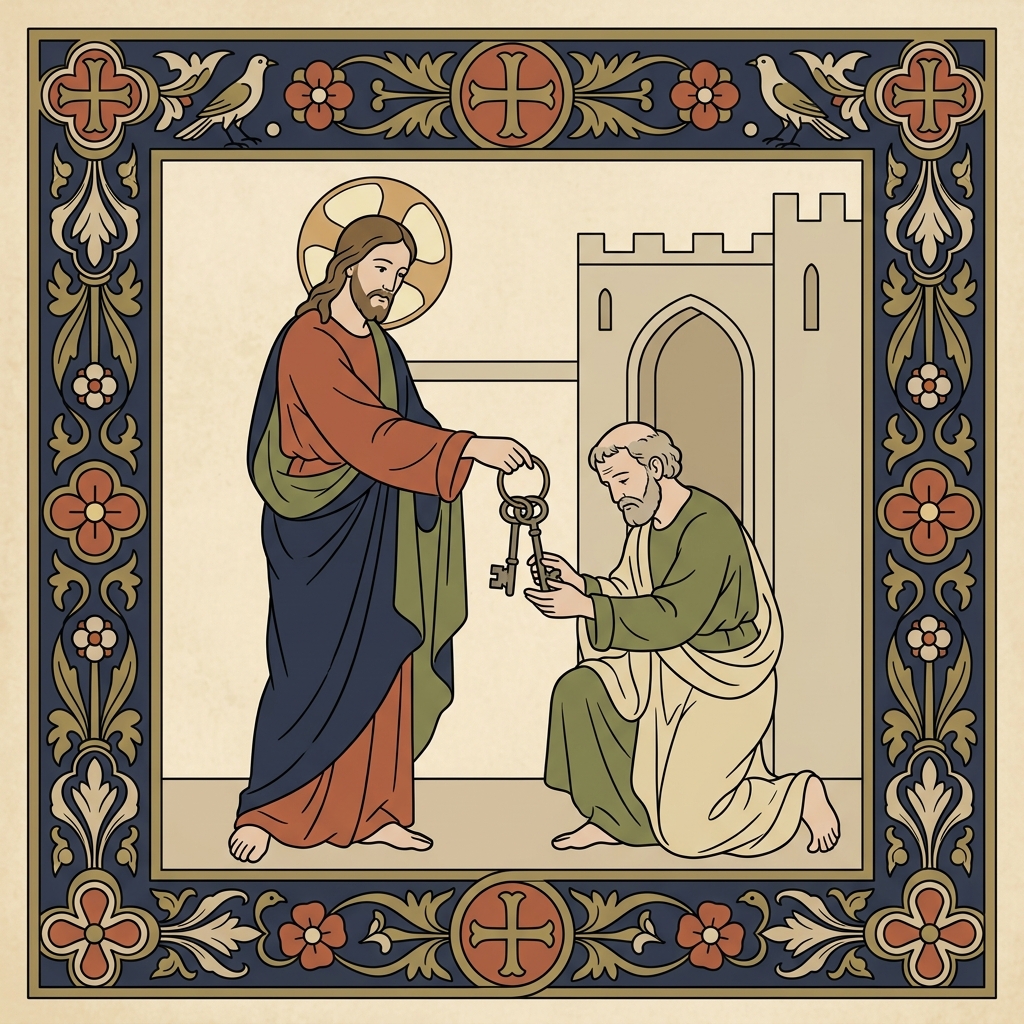
In the grand tapestry of salvation history, woven with threads of divine grace and human striving, there appear souls whose lives blaze forth as veritable beacons of God’s boundless mercy. Among these luminaries, whose sanctity shines with a particular intensity, stands Saint John of God, a man whose radical conversion and unwavering charity transformed him from a restless soldier into the devoted servant of Christ’s most afflicted members. His is a tale that echoes through the centuries, a testament to the transformative power of God’s love, ever relevant to the hearts of modern Catholics seeking to live lives consecrated to divine will.
The Prodigal’s Journey: From Wanderer to Witness
Born João Cidade in Montemor-o-Novo, Portugal, in the year of our Lord 1495, his early life was marked by an unsettling restlessness. At the tender age of eight, João departed from his home, a decision shrouded in youthful impetuousness or perhaps providential design, and spent many years as a shepherd, later as a soldier in the Imperial army, and eventually as a mercenary. His youth was not one of pious devotion, but rather of worldly pursuits and adventures, a life far removed from the sanctity he would later embrace. Yet, even amidst the din of battle and the cares of the world, the seed of faith, though dormant, was never truly extinguished.
The turning point, a veritable spiritual earthquake, occurred in Granada in 1537. It was there that João, then in his early forties, heard a sermon preached by the renowned St. John of Ávila. The words of this holy Doctor of the Church pierced his very soul, revealing the depth of his sins and the infinite mercy of God. Overwhelmed by contrition, João underwent a profound public conversion, crying out for mercy and confessing his past misdeeds with such fervor that he was thought by many to have lost his sanity. He was, in fact, committed to the Royal Hospital, reserved for the mentally infirm, where he experienced firsthand the deplorable conditions and cruel treatments inflicted upon the suffering.
This period of incarceration was not a punishment but a crucible, refining his spirit and shaping his future mission. He witnessed the dire need for compassionate care and resolved, by the grace of God, to dedicate his life to providing it.
Apostle of Charity: Founding a Legacy of Love
Upon his release, imbued with a burning zeal, João Cidade, now known as John of God, embarked upon his monumental work of charity. With no resources but an unshakable faith in Divine Providence, he began caring for the sick and the poor of Granada. He initially rented a house, which quickly became overcrowded, then acquired a larger one, which he transformed into a true hospital—not merely a place for physical healing, but a sanctuary of dignity and love for all who entered its doors, regardless of their ailment or social standing.
His method was radical: he would beg for alms during the day, crying out, "Do good, brothers, for yourselves!" and dedicate his nights to nursing the sick, comforting the dying, and attending to the spiritual needs of his patients. He often carried the most destitute and abandoned from the streets directly into his hospital. His boundless charity extended even to the mentally ill, whom he treated with unheard-of kindness and respect, believing them to be special children of God.
Such tireless devotion, often fueled by miraculous provision, drew others to his cause. Men inspired by his example joined him, forming the nucleus of what would become the Order of Hospitallers of Saint John of God, an order dedicated to the care of the sick and suffering, which continues its vital work throughout the world to this very day.
Virtues That Illuminate the Path
The life of Saint John of God is a veritable mirror reflecting numerous Christian virtues. Chief among them is supernatural charity (caritas), a love so profound that it saw Christ Himself in every suffering soul. His humility was equally profound, exemplified by his willingness to beg for the needs of his patients and his self-abasement during his conversion. His perseverance was legendary; despite exhaustion, ridicule, and immense challenges, he never faltered in his mission. He possessed an unwavering faith that God would provide, often seeing his prayers answered through unexpected alms or timely assistance. Finally, his self-sacrifice knew no bounds, giving his entire being, mind, body, and soul, to the service of his neighbor.
Saint John of God himself, ever consumed by zeal for souls and bodies, once exclaimed: "I would that I could multiply myself to be in all places, to succour all."
This fervent desire encapsulates the very essence of his life's work.
Miracles and a Holy Demise
The Lord, ever attentive to His faithful servants, often confirmed Saint John of God’s mission with signs and wonders. Perhaps the most famous occurred during a fire in the Royal Hospital of Granada. John, hearing the cries, rushed into the inferno, saving many patients and miraculously emerging unscathed despite re-entering the burning building multiple times to rescue others and sacred objects. Another account tells of an angel appearing to him to help distribute bread to his hungry patients.
Saint John of God labored ceaselessly until his physical strength was utterly spent. He fell ill after plunging into an icy river to rescue a drowning man. On March 8, 1550, on his 55th birthday, he knelt before a crucifix, clutching it to his breast, and rendered his soul to God, dying as he had lived: in an act of supreme humility and love. His feast day is celebrated annually on March 8th.
A Light for Our Age: Relevance to Modern Catholics
In an age often characterized by individualism and a crisis of compassion, Saint John of God stands as a towering inspiration. His story offers profound lessons for contemporary Catholics:
- The Power of Radical Conversion: His dramatic turning from a worldly life to one of complete devotion demonstrates that no one is beyond the reach of God's transforming grace. It is a message of hope for all sinners.
- Charity in Action: He reminds us that true faith is not merely intellectual assent but manifests itself in concrete acts of love for our neighbor, especially the most vulnerable. He models for us the corporal works of mercy.
- Dignity of the Marginalized: His compassionate care for the sick, the poor, and particularly the mentally ill, underscores the Church's timeless teaching on the inherent dignity of every human person, created in the image and likeness of God, regardless of their condition.
- Trust in Divine Providence: In a world that often demands self-reliance and immediate gratification, St. John of God’s unwavering trust that God would provide for his mission encourages us to place our anxieties and needs before the Lord with humble confidence.
Embracing the Call to Charity
Saint John of God calls us, from across the centuries, to open our hearts and hands to those in need, to see Christ in every suffering face. His life serves as a powerful evangelization, not through words alone, but through deeds of profound and sacrificial love. Just as he dedicated his life to healing and hope, Sanctus Mission strives daily to foster deep Catholic formation, equipping the faithful to live out their vocations of charity and service in the modern world. Let us, inspired by this Apostle of Charity, ask God for the grace to imitate his burning love for God and neighbor, transforming our communities one act of mercy at a time.