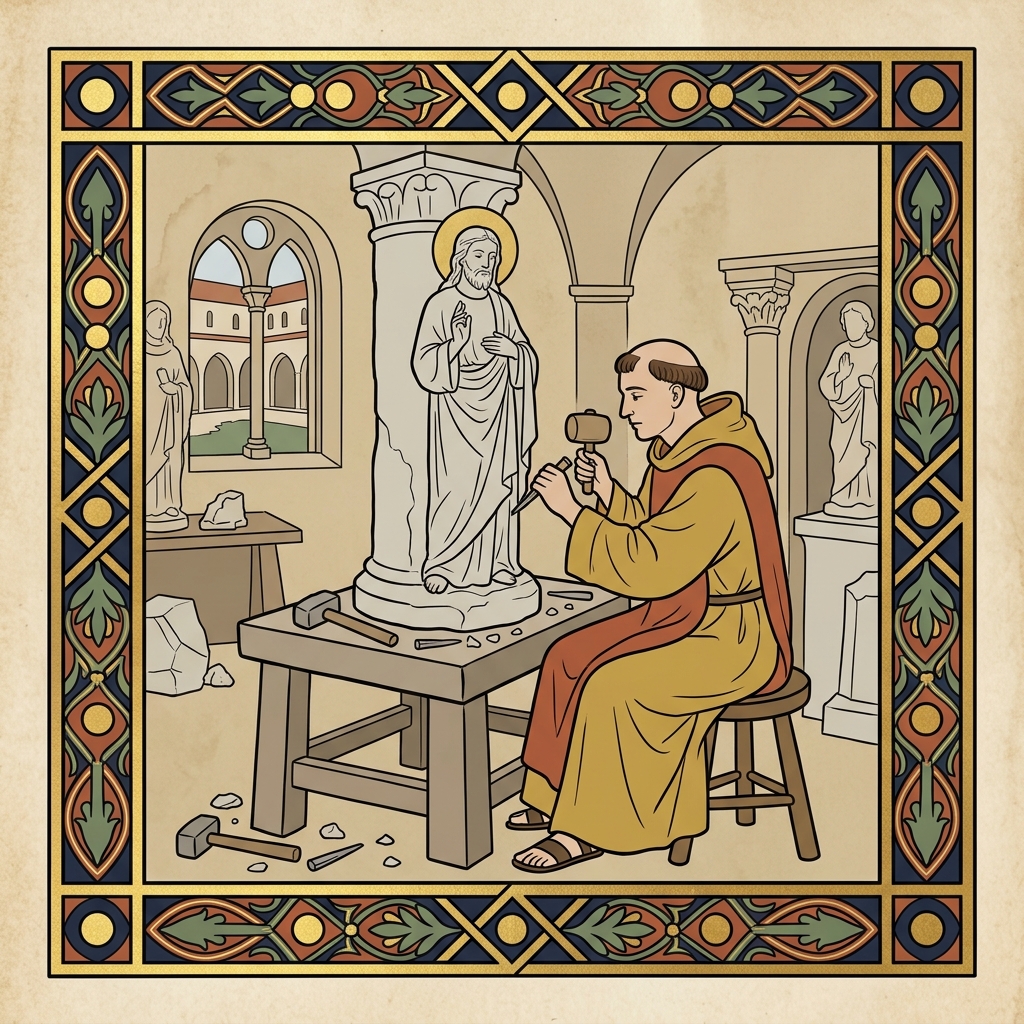
As autumn deepens and the golden light of late October fades into the chill of evening, the holy Church invites her children into a sanctuary of stillness. Throughout this Marian month, a sweet and ancient cadence echoes across Christendom—the rhythmic whisper of the Holy Rosary. Yet, behind the familiar smooth beads gliding through weathered fingers lies a spiritual tradition of noble majesty, born in the shadowed cloisters of medieval Europe and forged as a spiritual armor for every soul.
The Cloister in the Cottage
To understand the Rosary as the Church’s cherished faith practice, one must look back to the great monastic orders of the medieval countryside. In those holy houses, monks gathered seven times a day to chant the one hundred and fifty Psalms of David. For the lay brothers and peasant faithful working in the fields, however, the Latin texts were often unreadable and inaccessible. Desiring to unite their daily toil with the sacred liturgy of the monks, the faithful began substituting one hundred and fifty Pater Nosters (Our Fathers) and later, 150 Ave Marias (Hail Marys).
Thus, what we now know as the Rosary was originally cherished as Psalterium Beatae Mariae Virginis—Mary’s Psalter. It was the armor of the poor, enabling the humblest serf in the field to build a cloister within his own heart. As Saint Bernard of Clairvaux beautifully wrote of our Lady’s intercession: "In dangers, in doubts, in difficulties, think of Mary, call upon Mary. Let her name not depart from your lips, never depart from your heart."
The Christocentric Heart of the Mysteries
Far from being a vain repetition of words, the Rosary is fundamentally an encounter with the Divine Word Incarnate. The vocal prayers serve merely as a quiet beat—a sacred breathing—upon which the soul ascends to contemplate the mysteries of redemption. When we pray the Rosary, we view the life, death, and glorious resurrection of Our Lord Jesus Christ through the immaculate lens of His Blessed Mother.
As Pope Saint John Paul II reminded the universal Church in his apostolic letter Rosarium Virginis Mariae: "To recite the Rosary is nothing other than to contemplate with Mary the face of Christ." When we mediate upon the Joyful, Sorrowful, Glorious, and Luminous mysteries, we sit in the school of Mary. With her, we ponder the message of the Angel Gabriel; with her, we stand at the foot of the Holy Cross; with her, we marvel at the open tomb.
Restoring Reverence to the Sacred Cadence
In an age marked by modern distraction and chaotic speed, the medieval wisdom of the Rosary offers a profound antidote. It teaches us the sacred art of slow, interior contemplation. To pray the Rosary with true devotion requires us to reclaim the atmosphere of the sacred within our homes.
Consider these timeless practices to deepen your Marian devotion:
- Begin with Silence: Before taking the crucifix in hand, spend a moment in complete quiet to recollect your mind and place yourself consciously in the presence of God.
- State a Specific Intention: Before each decade, name a specific grace, virtue, or person for whom you offer the mystery.
- Engage Sacred Art: Gazing upon an icon or traditional religious painting corresponding to each mystery helps ground the imagination during contemplation.
- Embrace the Pause: Bow gently at the holy name of Jesus within every Hail Mary, acknowledging the central glory of His divine name.
When prayed in this deliberate, reverent spirit, the Rosary ceases to be a tedious duty and becomes what the medieval doctors named it: a spiritual garden, rich with fragrant virtues, where the soul walks peacefully alongside the Queen of Heaven.
Reflecting on the Tradition
How might you quiet the modern distractions of your day to make room for Mary’s Psalter, allowing her to lead your heart closer to the Sacred Face of her Son?