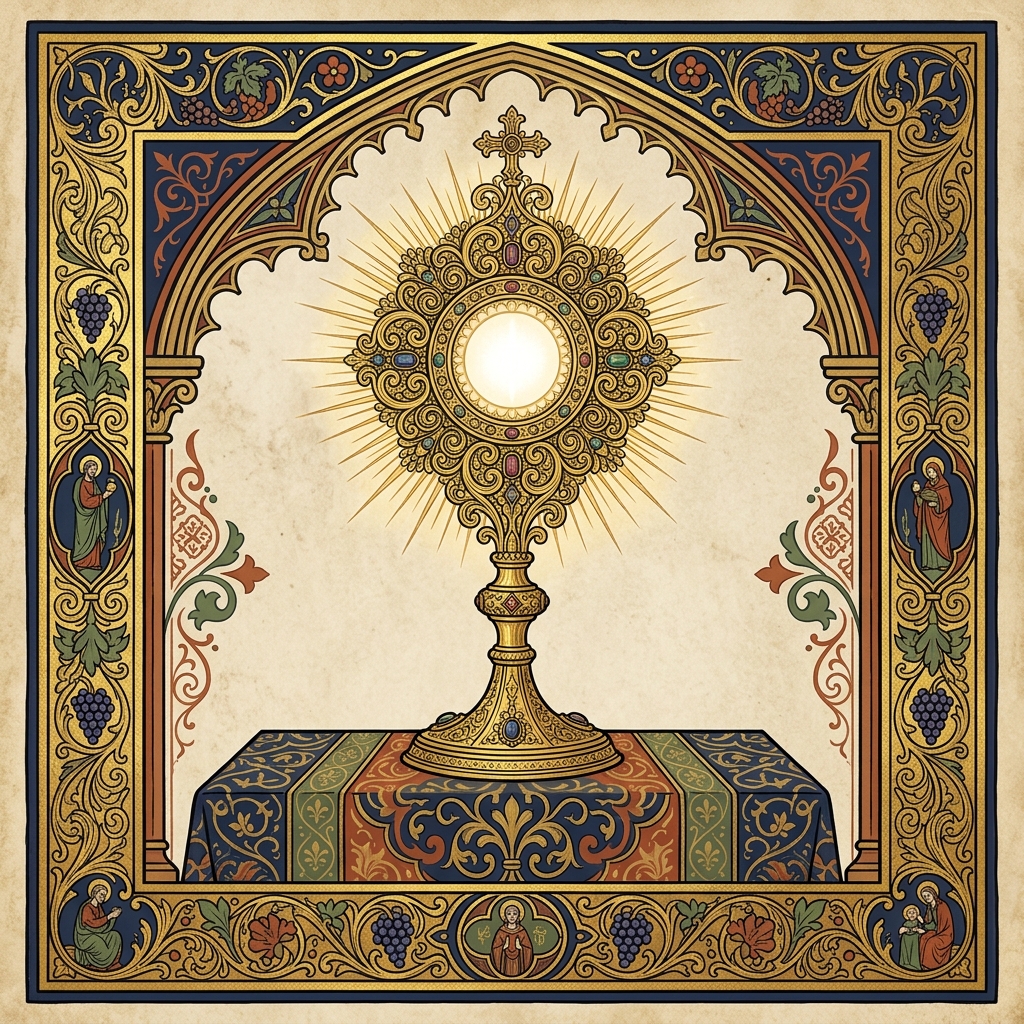
As the late summer heat settles upon the ancient stone of our churches, Holy Mother Church directs her gaze upward, anticipating one of the most sublime mysteries of our Catholic faith: the Assumption of the Blessed Virgin Mary. Beyond the transient haze of this earthly exile, we contemplate the Queen of Heaven elevated body and soul into the uncreated light of the Holy Trinity. In this noble dogma—solemnly defined by Pope Pius XII in 1950, yet deeply rooted in the apostolic memory of the Church—we discover not merely a solitary privilege granted to the Mother of God, but a radiant mirror disclosing the final destiny prepared for all who endure in grace.
The New Ark and the Incorruptible Vessel
From the dawn of Patristic tradition, the Sacred Fathers beheld in the Virgin Mary the total fulfillment of the Old Testament Ark of the Covenant. The ancient Ark, crafted from incorruptible acacia wood and covered in pure gold, carried within it the vessel of manna, the rod of Aaron, and the stone tablets of the Law. Yet how much greater is she who bore within her immaculate womb the true Bread from Heaven, the Eternal High Priest, and the Lawgiver Himself?
Saint John Damascene, writing in the eighth century, captured this exquisite theological continuity with timeless eloquence:
"It was fitting that she, who had kept her virginity intact in childbirth, should keep her own body free from all corruption even after death. It was fitting that she, who had carried the Creator as a child at her breast, should dwell in the divine tabernacles."
Because sin had never darkened her immaculate soul, the decay of the tomb—a direct fruit of original sin—could exert no claim over her sacred flesh. As the Psalmist mystically foretold, "Arise, O Lord, into thy resting place: thou and the ark which thou hast sanctified" (Psalm 131:8). In her Assumption, Christ the King welcomes His beloved Mother into the heavenly courts, exalting her as the first fruits of His decisive triumph over death.
Body and Soul Redeemed: A Defense of Human Dignity
In our modern era, humanity stumbles beneath two equal and opposite errors. On one hand, a hyper-materialism reduces the human person to a mere collection of biological functions; on the other, a subtle gnosticism treats the physical body as an irrelevant container to be manipulated or discarded at will. Against both falsehoods, Catholic doctrine stands as an unshakeable fortress of sacred truth.
The Assumption proclaims that Almighty God created the human person as an undivided unity of body and soul, and that Christ’s redemption encompasses the whole man. When Our Lady was assumed body and soul into paradise, human flesh was forever elevated into the realm of the divine. Her glorification guarantees that our physical bodies are not mere transitory husks, but sacred vessels destined for resurrection on the Last Day.
In his landmark Apostolic Constitution Munificentissimus Deus, Pope Pius XII proclaimed that this dogma serves as a perpetual defense of human dignity:
"In this magnificent manner, the exalted destiny of both our soul and our body is made strikingly clear to all. May the faithful be convinced that they are bound to honor and praise the Mother of God... and may they strive to imitate her virtues, so that the glory of the Mother may redound to the benefit of her children."
Walking in the Light of the Eternal Sunrise
To live in the light of Our Lady’s Assumption is to walk through this present world with a holy and noble detachment. It challenges us to guard our senses with chivalric purity, to treat our neighbors' bodies and souls with profound reverence, and to offer our daily labors as a fragrant sacrifice unto the Redeemer.
When we encounter physical suffering, bodily decline, or the grief of mortal loss, the Assumption whispers a holy and steadfast hope: the grave is not our enduring home. The same God who raised up the humble Virgin of Nazareth promises to restore our frail flesh in glorified majesty when all things are made new in Christ.
As we prepare our hearts for this glorious solemnity, let us cast off the sluggish weights of worldly anxiety and raise our eyes to the throne of God. For where the Queen Mother has trodden, her faithful children are called to follow.
How can contemplating Our Lady’s bodily Assumption transform the way you honor and care for the dignity of your own body and soul in daily life?