As the twilight of the Roman Empire cast long shadows over the civilized world, a young student in Rome looked upon the moral decay surrounding him and chose a divergent path. As we approach the feast of Saint Benedict of Nursia on July 11th, we honor a man who fled the crumbling grandeur of the eternal city to seek the eternal God. In our own age of digital clamor, shifting cultural foundations, and ceaseless anxiety, the Father of Western Monasticism stands as a towering lighthouse. He teaches us not merely how to survive the collapse of culture, but how to build an interior fortress of holiness within it.
The Flight from Tumult to the Cave
Fleeing the vanity and vice of his patrician education, Benedict withdrew to the rugged, mountainous wilderness of Subiaco. Here, in a solitary, wind-swept cave, he spent three years in intense prayer and asceticism. It is a profound irony of the Christian life that to heal the world, one must often first retreat from it. Benedict did not despise the world; rather, he recognized that a heart untethered from God is easily swept away by the rushing currents of the age.
In the deep silence of the cave, the young hermit learned to conquer himself. As Pope Saint Gregory the Great would later write of him, "He dwelt alone with himself, in the sight of his Creator, who beholds the hearts of all." This is the first and most noble lesson of Saint Benedict: before we can order our homes, our parishes, or our societies, we must allow God to order our souls in the sanctuary of silence.
Ora et Labora: The Noble Rhythm of Sanctity
When Benedict's radiant holiness inevitably drew disciples, he emerged from the cave not to impose harsh, unyielding burdens, but to craft a masterful blueprint for communal holiness. This became his famous Holy Rule, a document characterized by its brilliant moderation, paternal love, and profound understanding of human nature. At the very heart of this Rule is the timeless and grounding maxim: Ora et Labora—Pray and Work.
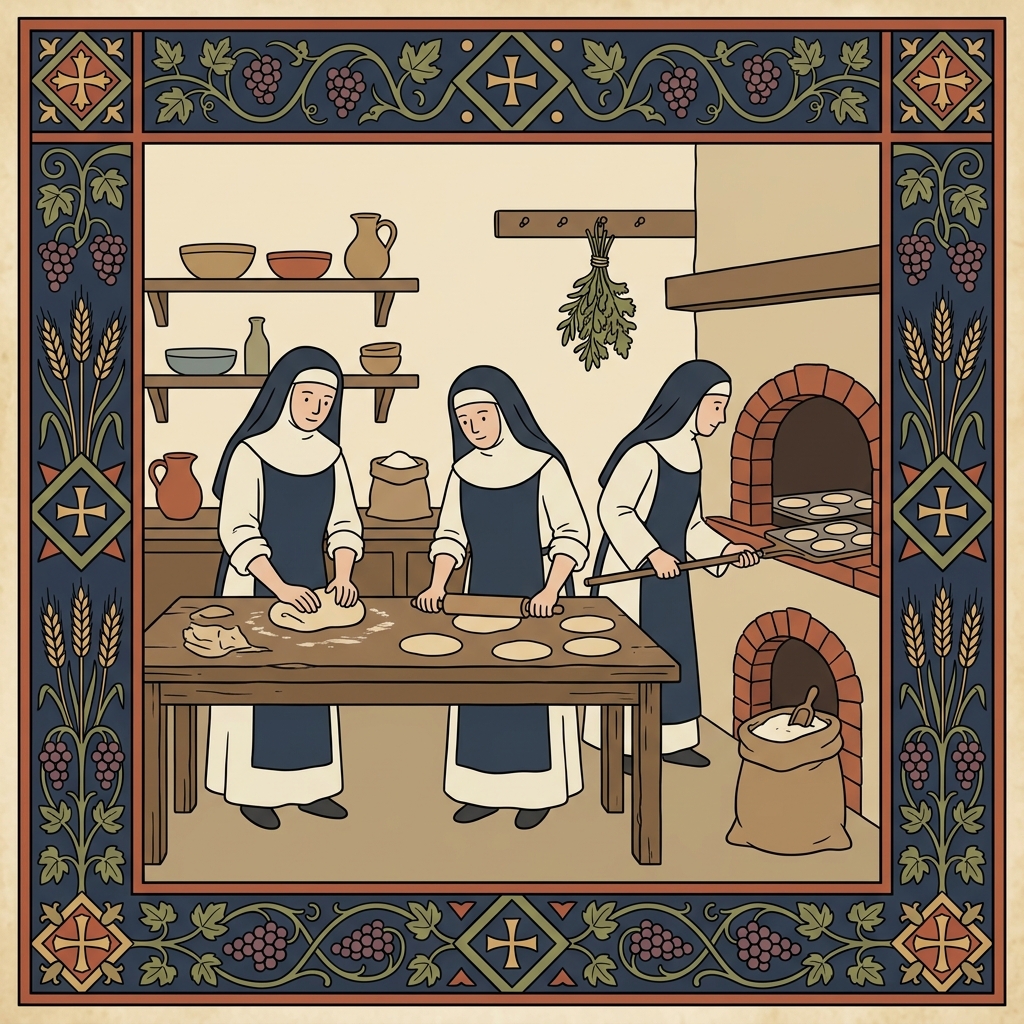
In the Benedictine vision, the altar and the anvil are forever united. Prayer is not an escape from duty, and labor is not a distraction from prayer. "Idleness is the enemy of the soul," Benedict solemnly warned his monks. Therefore, they were to dedicate themselves to the Work of God (Opus Dei) in the daily chanting of the Psalms, and to the work of human hands in the fields, kitchens, and scriptoriums. By elevating manual labor to the dignity of a spiritual offering, Benedict sanctified the ordinary. He reminds us today that folding laundry, balancing spreadsheets, and tending to the garden can be transformed into fragrant incense rising before the Throne of Grace, provided the labor is executed with a heart anchored in Christ.
The Monastery as a Citadel of Peace
To a fractured, war-torn world, Benedict offered the monastery as a bastion of order and charity. The word Pax (Peace) became the enduring motto of the Benedictine order. Yet, this peace was not merely the absence of conflict; it was the tranquility of right order. In the monastery, every vessel, every tool, and every soul had its proper place and sacred purpose. The things of earth were handled with the same reverence as the sacred vessels of the altar.
Benedict's famous command regarding hospitality reveals the astonishing depth of this ordered charity: "Let all guests who arrive be received like Christ, for He is going to say, 'I came as a guest, and you received Me.'" The monastery was to be a beacon of Christian nobility, where the beggar, the pilgrim, and the nobleman were treated with the exact same profound reverence. In a modern society plagued by isolation and transactional relationships, this radical, self-emptying hospitality challenges us to view every person who crosses our threshold as the hidden Christ.
Practical Lessons for the Modern Pilgrim
We are not all called to wear the black habit or dwell within cloistered walls, but the spirit of Saint Benedict’s Rule is profoundly adaptable to the lay vocation. How, then, do we build our own citadels of peace in the twenty-first century?
First, we must carve out our own "cave of Subiaco" each day—a dedicated time of silent mental prayer where the noise of the world is banished, and we listen, as the opening prologue of the Rule beautifully commands, "with the ear of your heart."
Second, we must establish a noble rhythm in our homes. When our days are fractured by endless digital scrolling and unstructured busyness, we surrender our peace. By instituting a deliberate, daily schedule of prayer, meaningful work, and intentional rest, we reclaim the dignity of time.
Lastly, we must cultivate radical hospitality. Whether it is inviting a lonely neighbor for a warm meal, opening our homes for a rosary group, or simply offering a deeply attentive ear to a struggling colleague, we are called to be sanctuaries of Christ’s presence in a weary, wandering world.
Saint Benedict did not set out to save Western civilization; he simply set out to save his own soul. Yet, by seeking God above all things, he laid the immovable foundations for a Christian culture that would endure for millennia. As we celebrate his feast day, let us ask for his intercession to build our own lives upon the imperishable bedrock of Christ.
Reflection Question: Looking at the week ahead, what is one specific area of your daily routine where you can better integrate the noble, grounding rhythm of Ora et Labora (Pray and Work)?