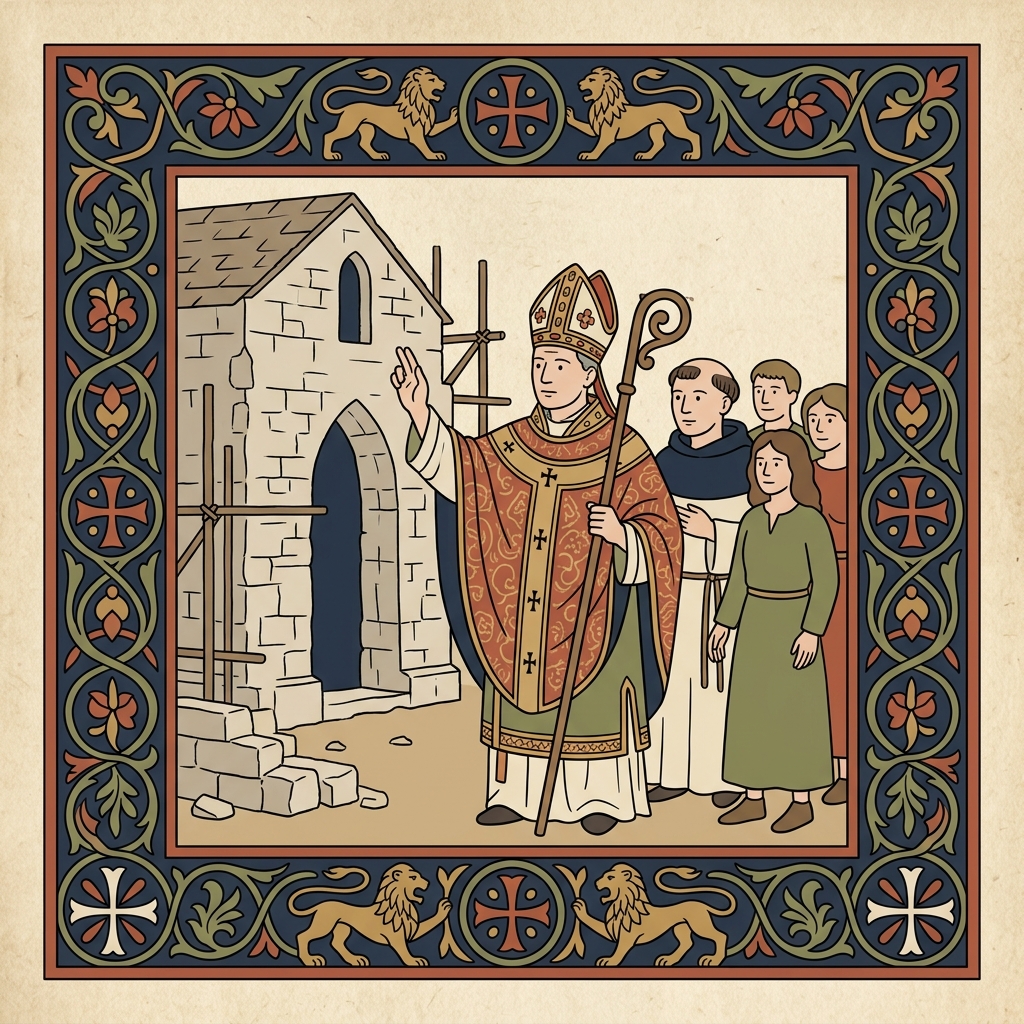
Amidst the towering crags of the Peruvian Andes, where the morning mist clings to the terraced slopes like the incense of a high altar, lies the village of San Rafael. Here, the air is thin, the earth is rugged, and the faith of the people runs as deep as the ancient valleys. Yet, even in this majestic highland, the trials of the fallen world press heavily upon the faithful. It is here that Sanctus Mission has found its latest endeavor—a call to rebuild not merely a structure of wood and stone, but a citadel of human dignity and divine grace.
The Ruin and the Resolve
Last winter, a tempest of uncommon fury swept through the Andean peaks. The relentless winds tore the tin and timber roof from the village's humble chapel, a dual-purpose sanctuary that also served as the region's sole medical dispensary for nearly fifty miles. For the indigenous farmers and their families, the loss was absolute. The elements threatened to wash away the mud-brick walls, leaving the Eucharist without a worthy tabernacle and the sick without a refuge from the bitter mountain cold.
Padre Elias, a Franciscan missionary whose habit is perpetually dusted with the red clay of his parish, refused to yield to despair. He knew that the Church, much like the formidable stone fortresses of old, is built to weather the fiercest storms. "The wind may take our roof," Padre Elias wrote in an early dispatch to our Sanctus Mission team, "but it cannot uproot the foundation of Christ. We will rebuild, and we will make it stronger. We only need the timber to begin."
Timber from Afar: The Guild of the Faithful
In medieval Christendom, the raising of a cathedral was never the work of a single man. It was the triumph of a guild—a fellowship of stonemasons, carpenters, glassmakers, and humble peasants who gave their meager coppers to see a spire pierce the heavens. Today, that same spirit animates the Sanctus Mission community. Through your steadfast patronage, whether by purchasing our goods or offering your alms and prayers, you have become the modern guild for the faithful of San Rafael.
In May, funds from Sanctus Mission arrived in the valley. They were transformed not into abstract charity, but into tangible grace: sturdy beams of high-grade timber, heavy canvas tarps to protect the walls during construction, masonry tools, and essential medical supplies to restock the ruined clinic. When the trucks bearing these gifts finally navigated the treacherous, winding mountain passes to arrive at the village square, the bells of the ruined chapel were rung in a jubilant chorus of thanksgiving.
The Altar of the Poor
The rebuilding of San Rafael’s mission is a profound testament to the incarnational reality of our Catholic faith. We do not minister to souls in isolation from the body. As St. John Chrysostom boldly proclaimed:
"Do you wish to honor the body of Christ? Do not ignore him when he is naked. Do not pay him homage in the temple clad in silk, only then to neglect him outside where he is cold and ill-clad."
By restoring the medical dispensary alongside the sanctuary, the mission embodies this ancient truth. The new timber beams will shelter a refurbished altar where the Sacrifice of the Mass is offered, and just a room away, those same beams will shelter a clinic where the wounds of the sick are bound. It is a singular house of healing. The physical restoration of the building mirrors the spiritual restoration of the people, demonstrating that the Church is truly a mother who gathers her children under her protective mantle.
A Cathedral of Living Stones
Today, if you were to walk the muddy paths of San Rafael, you would hear the rhythmic strikes of hammers and the scraping of trowels against stone. You would see men and women, weathered by the altitude and the sun, working side by side with Padre Elias. They are mixing mortar and hoisting beams with a reverence typically reserved for the liturgy itself.
St. Peter exhorts us in his first epistle: "Like living stones, let yourselves be built into a spiritual house, to be a holy priesthood, to offer spiritual sacrifices acceptable to God through Jesus Christ" (1 Peter 2:5). The physical stones of the San Rafael mission are being laid by the living stones of its parishioners, bolstered by the living stones of the Sanctus Mission community thousands of miles away.
We are separated by oceans, languages, and towering mountain ranges, yet we are united in the One Body of Christ. Every nail driven into the new roof of San Rafael is a testament to the enduring power of Catholic brotherhood. Because of your support, the Eucharist will once again be celebrated in a fitting sanctuary, and the sick will be tended to with the dignity befitting children of God.
The Work Continues
As the walls rise higher into the Andean mist, we give thanks to God for the privilege of participating in His great work. The story of San Rafael is not yet finished, nor is the work of Sanctus Mission. There are countless other outposts of faith waiting for the provision to build, to heal, and to preach the Gospel. Let us continue to labor in the Lord’s vineyard, knowing that whatever we build for His glory will echo into eternity.
Reflection Question: In what ways is God calling you to be a "living stone" today, helping to build up His Church in your own home, parish, or community?