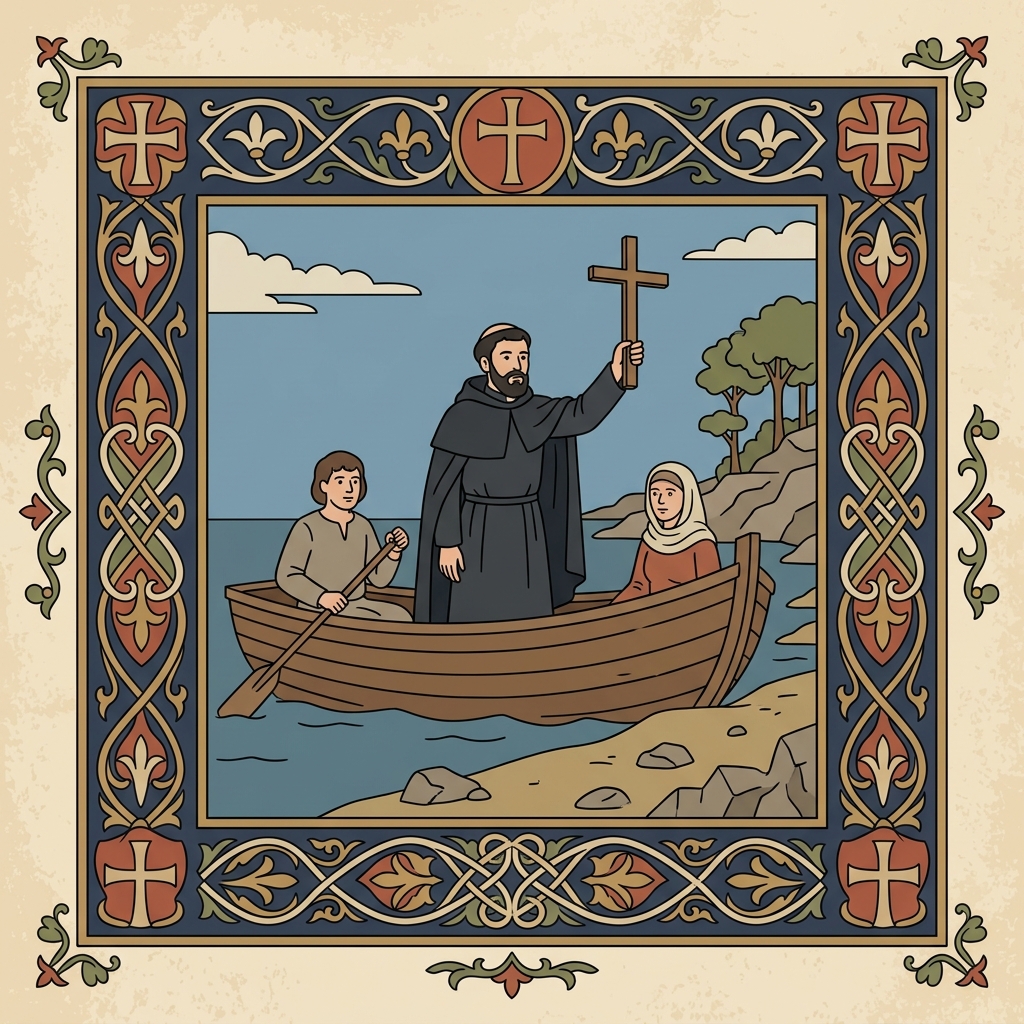
In the twilight of the Roman Empire, when the lamps of classical civilization seemed to dim, a fierce and radiant fire was kindled on the rugged coastlines of Ireland. Here, the Catholic faith did not merely survive; it flourished with a wild, apostolic vigor. Among the towering figures of this Celtic Golden Age is Saint Brendan of Clonfert, known to the ages as Saint Brendan the Navigator. As we celebrate his feast day on May 16th—a date beautifully aligned with this Sunday's contemplation—we are invited to look upon this holy abbot not merely as a legendary explorer of the seas, but as a fearless pioneer of the spiritual life.
The Call of the Peregrinatio
To the medieval Irish monks, the concept of peregrinatio pro Christo—exile for the sake of Christ—was a profound spiritual discipline. It was hailed as the "white martyrdom." Unlike the red martyrdom of blood, this path involved voluntarily leaving one's homeland, casting oneself upon the unpredictable currents of the sea, and trusting entirely in Divine Providence. Born around the year 484 in County Kerry, Brendan was exquisitely formed in this heroic tradition.
Before he ever commanded a vessel, Brendan was steeped in the rich contemplative silence of the Irish saints. Fostered by Saint Ita, known as the "Brigid of Munster," the young Brendan was taught that the three things most pleasing to God are true faith born of a pure heart, a simple life wedded to a religious spirit, and open-handed charity. This interior formation was his truest anchor. Without the silence of the monastic cell, the monk cannot survive the deafening roar of the sea.
After founding several monasteries, most notably the great abbey at Clonfert, the stirring of the Holy Ghost called him to the waters. Legend tells us that Brendan and a company of brother monks constructed a coracle—a simple vessel woven of wattle and covered in ox hides tanned with oak bark. Fortified by fasting and the Sacraments, they set out onto the churning gray expanse of the Atlantic, seeking the Terra Repromissionis Sanctorum, the Promised Land of the Saints.
Navigating the Tempests
The Navigatio Sancti Brendani (The Voyage of Saint Brendan), a jewel of medieval Catholic literature, recounts their epic journey through towering waves, encounters with sea monsters, and passages through pillars of crystal. While the rigidly modern mind may dismiss these accounts as mere folklore, the medieval Christian understood them as profound spiritual topography.
"Christ is the ship's captain, and He will guide us," Brendan assured his trembling brothers when rogue storms threatened to swallow their fragile craft. In our own lives, we are often battered by the sudden gales of anxiety, temptation, and sorrow. The modern world is a restless ocean, and our fallen natural inclination is to cling desperately to the shores of comfort and worldly illusion. Saint Brendan teaches us a noble truth: true peace is not found by avoiding the storm, but by entirely surrendering the helm to Christ.
The Rhythm of the Oars, The Rhythm of Prayer
What is perhaps most striking about Brendan’s legendary voyage is the unyielding commitment to the monastic rule. Whether becalmed under a scorching, windless sky or tossed by violent, freezing gales, the monks faithfully chanted the Divine Office. They celebrated the Holy Sacrifice of the Mass upon rocky, desolate isles—and, as the beloved legend goes, once upon the back of a great sleeping whale.
Their physical journey was entirely subsumed into the liturgical life of the Church. Herein lies a vital and urgent lesson for the modern Catholic. How often do we allow the chaos of our schedules, the demands of our secular work, or the sudden crises of life to disrupt our daily life of prayer? Saint Brendan stands as an imposing witness that the Sanctus bells must ring out even amidst the roaring waves. The rhythm of the oars must be matched by the rhythm of the Psalms. If we abandon our prayers when the waters grow rough, we abandon the very vessel that keeps us from drowning.
Casting Off the Bowlines
Saint Brendan’s ultimate destination was not merely a geographical location upon a map, but the very heart of God. Today, this noble saint challenges the complacency of our modern age. We are too often satisfied with a domesticated faith, seeking a religion that provides mere emotional consolation without demanding radical transformation. But the Gospel is a majestic call to the deep. Duc in altum. Put out into the deep water.
As you sit this Sunday, perhaps sipping a warm coffee in the quiet of the morning, look to the horizon of your own soul. What earthly attachments are tethering you to the docks of mediocrity? What fears prevent you from hoisting the sail of faith and letting the breath of the Holy Ghost carry you into deeper, holier waters?
Let us make our own the traditional Celtic spirit of his seafaring prayer: "Help me to journey beyond the familiar and into the unknown. Give me the faith to leave old ways and break fresh ground with You."
Reflection: What is one "safe shore" in your life that God is calling you to leave behind in order to trust more profoundly in His Divine Providence?