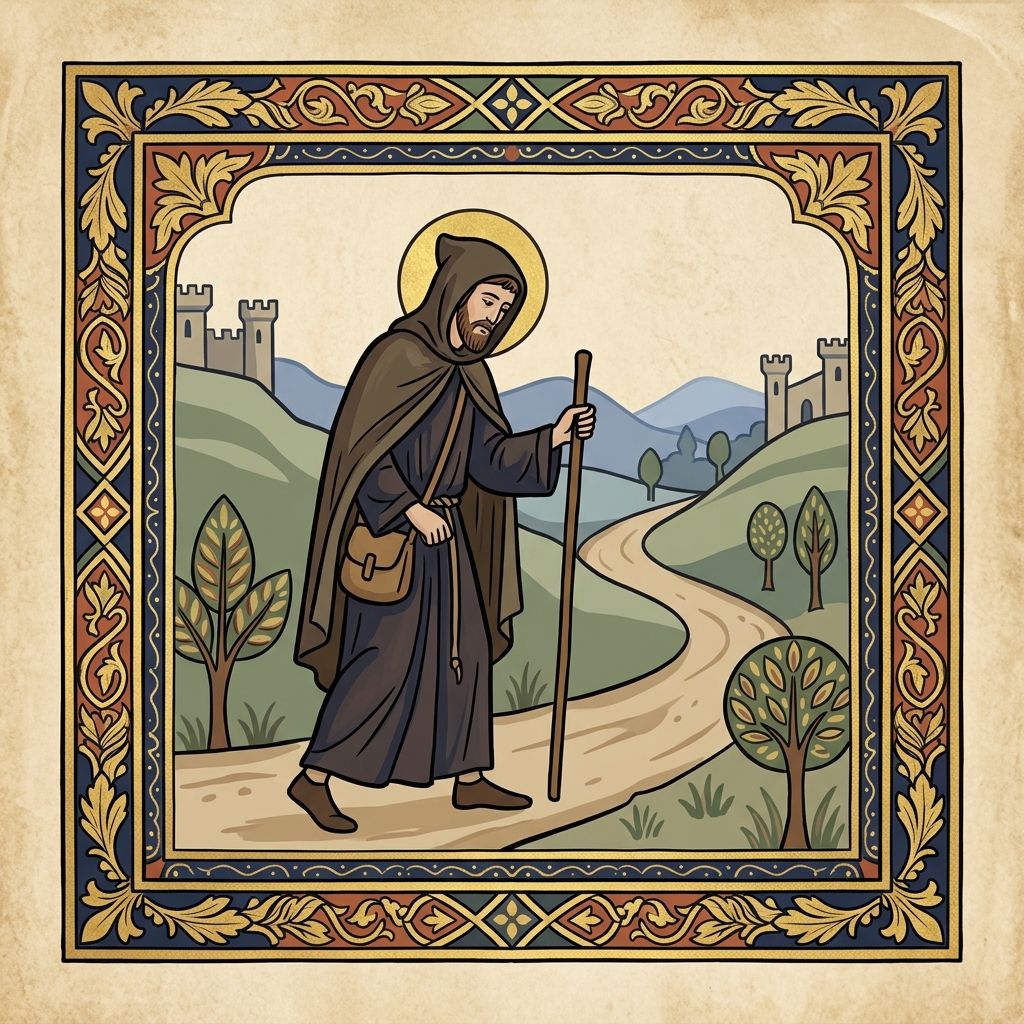
Hark, beloved brethren in Christ, for today we turn our gaze to a luminous, though often overlooked, star in the firmament of saints: Saint Drogo of Sebourg. His feast, observed on the fourteenth day of July, calls us to ponder a life steeped in extraordinary penance, profound humility, and a singular devotion that transmuted earthly suffering into celestial glory. In an age ever seeking comfort, Drogo's radical embrace of the Cross offers a stark, yet infinitely consoling, path to sanctity.
The Weight of a Birthright: Early Life and Penance
Born into nobility in Epinoy, France, in the year of our Lord 1105, Drogo's earthly journey began under the shadow of a profound tragedy: his mother, alas, surrendered her life during his very birth. This sorrowful truth, concealed from him for many tender years, struck his pious heart with devastating force upon its revelation in his youth. Overwhelmed by a sense of personal culpability, despite the manifest innocence of a newborn, Drogo resolved to dedicate his life to God in expiation and humble service. He renounced his considerable inheritance, distributed his wealth to the poor, and embarked upon a life of severe penance and pilgrimage.
For several years, this noble soul journeyed across Europe as a solitary pilgrim, traversing vast distances on foot to sacred shrines, including no fewer than nine arduous journeys to the Eternal City of Rome. His fervent prayers and mortifications were an earnest plea for divine mercy, a testament to a soul acutely aware of sin, yet equally confident in God's boundless grace. His humility was such that he preferred to live as a mendicant, often working as a simple shepherd in Sebourg, near Valenciennes, tending the flocks with a tender heart and ever-present prayer.
The Anchorite of Sebourg: A Life Transformed
Divine Providence, ever guiding the paths of the just, led Drogo to Sebourg. Here, his life took an even more austere turn. Afflicted by a severe rupture or hernia, which tragically disfigured him and rendered him a pitiable sight, Drogo chose not to bemoan his fate but to embrace it as a further means of conformity to Christ's passion. Mistaken for one suffering from leprosy due to his outward appearance, he willingly accepted isolation, choosing to live as an anchorite.
For forty-five years, until his blessed repose in 1186, Saint Drogo dwelt in a tiny, humble cell scarcely larger than a grave, attached to the side of the parish church in Sebourg. His sole window allowed him to witness the sacred mysteries of the Holy Mass and to receive the Bread of Life. During this extended period of solitary contemplation and rigorous prayer, the Almighty bestowed upon him extraordinary graces. It is recorded that he was frequently observed in two places at once – simultaneously assisting at Mass within his cell and tending his sheep in the distant fields, a miraculous manifestation of bi-location.
Furthermore, near his anchorhold, a miraculous spring welled forth, its waters renowned for their healing properties, a tangible sign of God's favor upon His humble servant. Drogo’s life in that cell was a living testament to the power of detachment, silence, and persistent prayer, proving that true freedom is found not in worldly pursuits but in utter surrender to God's will.
Virtues for the Modern Soul
Saint Drogo's life, though separated from us by centuries, resonates with profound relevance for the modern Catholic. His profound humility in acknowledging a perceived sin, and his subsequent radical penance, challenges our often superficial understanding of repentance. In a world obsessed with self-image and fleeting beauty, his acceptance of physical disfigurement teaches us the virtue of detachment from the corporeal and the profound beauty of a soul dedicated to Christ.
His unwavering faith and perseverance in prayer, even amidst isolation and suffering, remind us that God is ever-present, especially in our trials. He teaches us the value of solitude – not as an escape from the world, but as a deeper encounter with its Creator. Drogo's patronages are diverse: shepherds, coffee house keepers, those suffering from gallstones and ruptures, and even, poignantly, 'unattractive people.' This latter patronage beautifully underscores his message: true beauty is found not in the fleeting outward appearance, but in the radiant spirit shaped by God's grace.
"It was pride that changed angels into devils; it is humility that makes men as angels." — Saint Augustine of Hippo
Saint Augustine's words find a vivid illustration in Drogo's life. He chose humility over the pride of his birthright, transforming his perceived infirmity into a source of spiritual strength and a profound witness to God's transformative power.
A Call to Interiority and Grace
Saint Drogo, the anchorite shepherd, stands as a perpetual invitation to cultivate an interior life rooted in Christ. His story beckons us to examine our own relationship with suffering, our willingness to embrace penance, and the depth of our humility. In a world saturated with noise and distraction, his cell reminds us of the sanctity of silence and the necessity of drawing close to God in prayer.
May his intercession inspire us at Sanctus Mission to pursue greater holiness, to find grace in our daily trials, and to ever remember that true worth lies not in worldly acclaim or physical perfection, but in a soul wholly dedicated to the love of God and neighbor, mirroring the radiant beauty of Christ Himself.