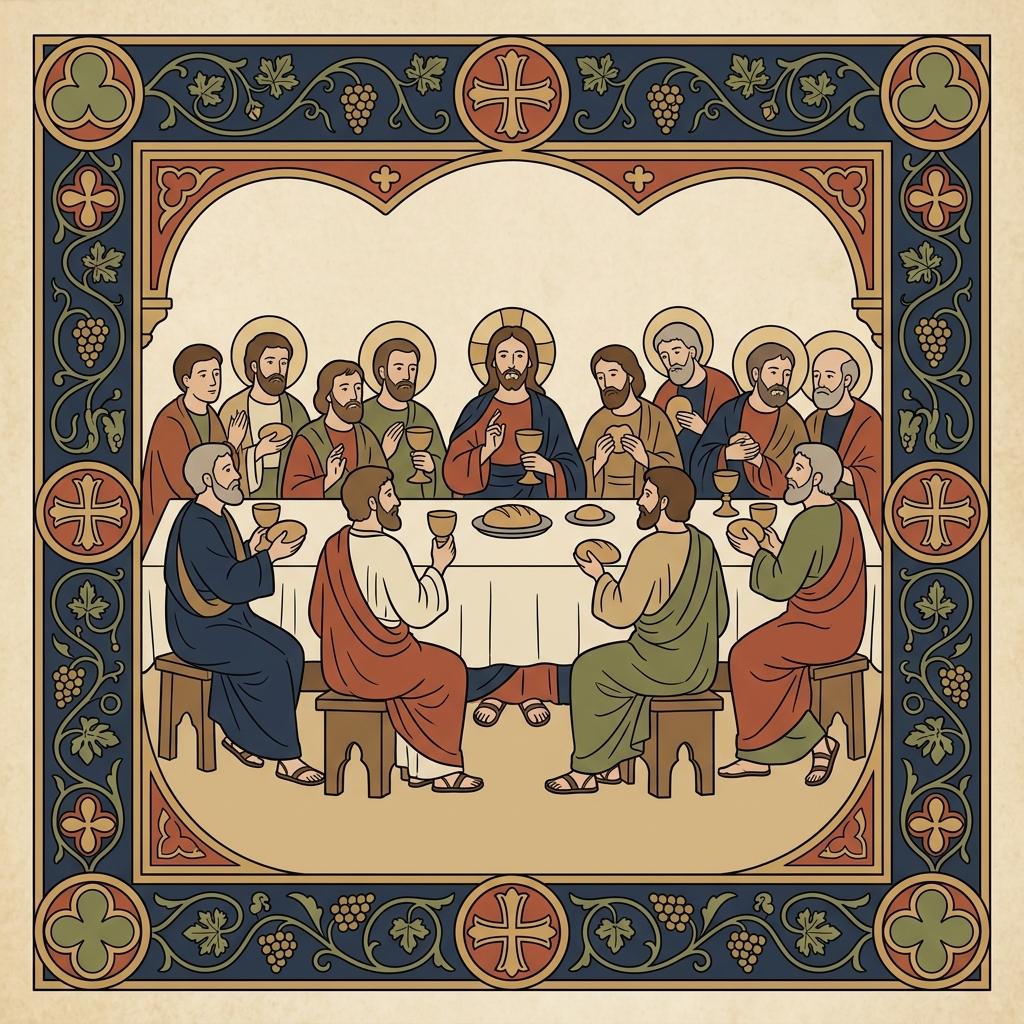
The Church, in her ancient and maternal wisdom, turns her gaze on this third day of July to a mighty pillar of the Apostolic foundation: Saint Thomas, called Didymus. Often relegated to the shadows of a singular moment of hesitation, he is colloquially branded "the Doubter." Yet, to view this noble saint through the narrow lens of a fleeting weakness is to miss the magnificent architecture of his faith. Thomas was a man of visceral realism, a soul who demanded that the promises of God take on the weight of flesh and blood.
The Courage of the Twin
Before the shadows of Good Friday eclipsed the joy of the disciples, Thomas demonstrated a chivalric loyalty to the Master. When Christ resolved to return to Judea to awaken Lazarus—stepping into a veritable den of wolves awaiting the Shepherd—it was Thomas who rallied his terrified brethren with the battle cry of a true liegeman: “Let us also go, that we may die with him” (John 11:16). Here we see no fragile skeptic, but a man of bracing courage, ready to follow his Lord into the crucible of suffering.
The Crucible of the Upper Room
Yet, the trauma of Calvary shattered their fellowship. When the Risen Lord first pierced the gloom of the Upper Room on Easter Sunday, Thomas was absent. Imagine the agony of the ensuing week. His brethren, alight with the fire of the Resurrection, testified to the impossible, while Thomas remained anchored in the sorrow of the tomb. His demand to place his finger in the nail marks and his hand into Christ’s side was not born of cynical atheism, but of a broken heart seeking the ultimate vindication of Love. He needed to know that the God of glory was still the God of the cross.
Touching the Sacred Scars
Eight days later, the doors being shut, the King of Peace stood once more in their midst. Christ did not offer Thomas a rebuke of wrath, but an invitation of unfathomable mercy. He laid bare the trophies of His Passion. Pope Saint Gregory the Great captures the majesty of this moment in his homilies: “The disbelief of Thomas has done more for our faith than the faith of the other disciples. As he touches Christ and is won over to belief, every doubt is cast aside and our faith is strengthened.”
In touching the sacred scars, Thomas’s hesitation collapsed into the most profound theological declaration found in all the Gospels. Falling to his knees before the wounded, triumphant King, he cried out: “My Lord and my God!” (John 20:28).
To the Ends of the Earth
The grace of the Resurrection forged Thomas into a weapon of light. Tradition holds that the Apostle whose faith was born anew in the Upper Room carried the Gospel to the furthest frontiers of the known world, reaching the shores of India. It is beautifully fitting that medieval lore names him the patron of builders and architects, for it was Thomas who first beheld the foundational cornerstone of our faith—the resurrected flesh of the Word—and then went forth to build the Church in the East.
The man who once demanded to touch the wounds of Christ spent the remainder of his life binding up the spiritual wounds of a pagan world. He planted the cross in foreign soil and watered it with his own martyr’s blood. He was pierced by a spear—a poetic and glorious echo of the very wound he once sought to probe in his Savior's side.
Lessons for the Modern Pilgrim
For those of us traversing the valleys of the modern age, Saint Thomas stands as a patron of honest, unrelenting pursuit of truth. First, he teaches us to bring our authentic struggles to the altar. The Lord does not despise our wrestling; He meets us in the locked rooms of our anxiety and offers His wounded heart as our refuge.
Second, Thomas instructs us to anchor our faith not in abstract philosophies, but in the physical reality of the Incarnation. We encounter this reality most profoundly in the Most Holy Eucharist. When the priest elevates the Host at the consecration, the same Risen Lord makes Himself tangible to us today. The traditional piety of silently echoing Thomas's words—“My Lord and my God”—at the elevation is a beautiful practice that anchors our minds in this unbroken Apostolic faith.
When the shadows of uncertainty creep into the citadel of our minds, let us borrow the battle cry of Saint Thomas. Let us gaze upon the crucifix, and declare with absolute surrender that the wounds of Christ are the very gates of heaven.
Reflection Question: What locked doors in your own heart need the Risen Christ to enter today, and are you willing to touch His glorious wounds to find healing for your own?